Anthropic Confirms: AI is Making Coders Dumber
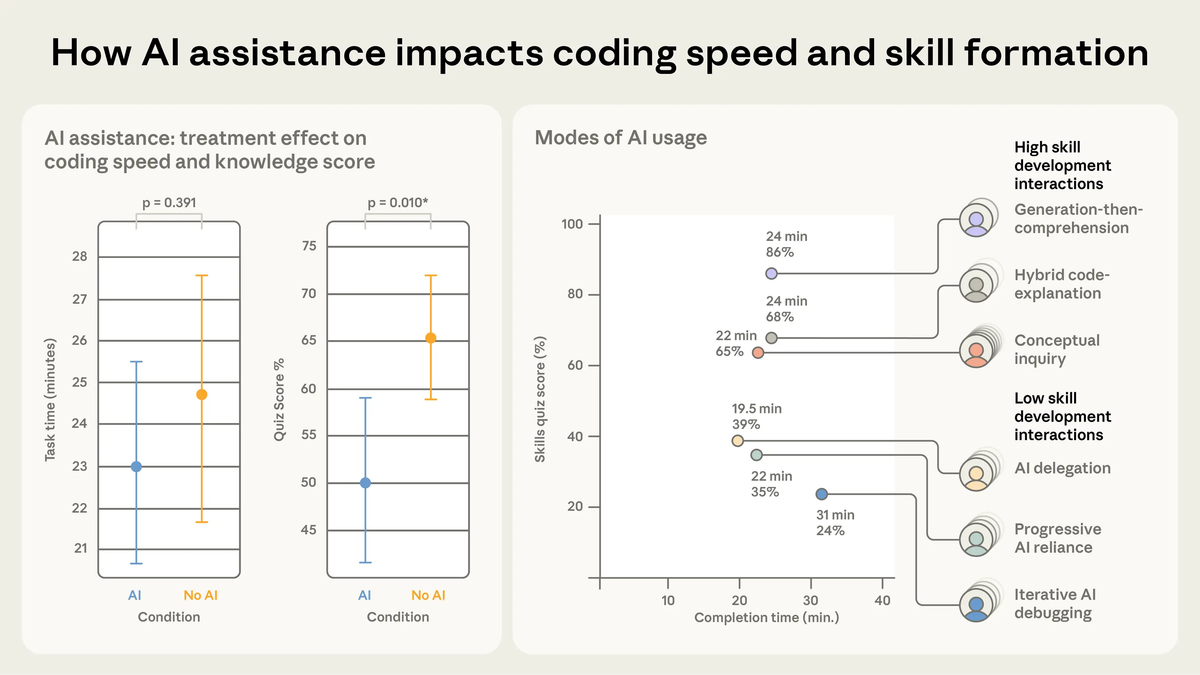
“AI use impairs conceptual understanding, code reading, and debugging abilities, without delivering significant efficiency gains on average.”
I have been warning of the long-term negative impacts of AI-overreliance for a long time. I continue to believe deeply in its potential—a potential available today but realized by so few.
I have argued that 95% of users treat AI as a substitute for thinking (“Outsourcers”) or a mirror for their pre-existing beliefs (“Validators”). For this 95%, AI assistants aren't tools; they are evolutionary black holes. [1]
Many people don’t want to hear this. They call it pessimism. But here is the inconvenient truth: the opening quote isn’t mine. It is a research finding from Anthropic’s own analysis of how Claude Code impacts developers.
I deeply admire Anthropic’s research team for releasing this report. It takes real courage for a company to say, "Our industry is failing to meet its promise, and we are owning the data." [2]
Their report echoes my own findings on cognitive outsourcing and labor stagnation, central themes in my upcoming book, Robot-Proof (see comments below) But Anthropic was uniquely positioned to test a specific, hopeful hypothesis: the idea of Osmotic Learning. Even if coders are outsourcing the work, does simply interacting with high-quality AI code train them to be better?
The answer is a resounding no.
For the vast majority, using AI assistants does not lift capabilities—it degrades them. We’ve seen this in general-purpose AI tutors, we've seen it in "creativity" assistants, and now Anthropic has confirmed it in coding.
When you remove the friction of the work, you remove the signal required for learning—it’s just how our dumb brains work.
AI truly can be transformative. It already is for a vanishing few (the "Cyborgs" who use it to think harder). But for now, for the majority, AI is largely transforming us into worse versions of ourselves.
[1] The 5%: From my upcoming paper. Who are the remaining 5% that truly soar? The Cyborgs. Be patient: there’s so much more to come. :)
[2] Not Just Claude: This is in no way specific to Claude Code. All coding assistants likely produce similar effects. Obsessed with "autonomous agent" benchmarks, they all give you what you want (the answer), not what you need (the understanding).
Original Report: https://arxiv.org/abs/2601.20245
Anthropic’s Post: https://www.anthropic.com/research/AI-assistance-coding-skills
Read More in Robot-Proof: When Machines Have All The Answers, Build Better People
- Chapter 13: “How to Robot-Proof Your Kids”
- Chapter 14: “How to Robot-Proof Yourself”
- Chapter 16: How to Robot-Proof Your Company”
I offer no easy answers, just a serious call for massive change. https://socos.org/robot-proof
Stage & Screen
- March 8, Basel: I'll be giving a keynote at the Health.Tech Global Conference 2026: "Robot-Proof: How Human Agency Drives Hybrid Intelligence & Discovery"
- March 8, LA: I'll be at UCLA talking about AI and teen mental health at the Semel Institute for Neuroscience and Human Behavior.
- March 12, Santa Barbara: Economic development on the Central Coast.
- March 14, Online: The book launch! Robot-Proof: When Machines Have All The Answers, Build Better People is will finally be inflicted on the world.
- Boston, NYC, DC, & Everywhere Along the Acela line: We're putting together a book tour for you! Stay tuned...
- Late March/Early April, UK & EU: Book Tour!
- March 30, Amsterdam: What else: AI and human I--together is better!
- plus London, Zurich, Basel, Copenhagen, and many other cities in development.
- April 14, Seattle: Ill be keynoting at the AACSB Business School Conference.
- May 12, Online: I'll be reading from Robot-Proof for the The Library Speakers Consortium.
- June, Stockholm: The Smartest Thing on the Planet: Hybrid Collective Intelligence
- October, Toronto: The Future of Work...in the Future