Comedy Bang Bang, have me as guest

Just because I don't research funny things doesn't mean I can't talk science with the Pigshit Twins!
Research Roundup
Baby I Can Drive Your Car
Out of 8,972,221 million death certificates across 443 occupations, taxi and ambulance drivers had the lowest proportion of deaths from Alzheimer's disease.
No other major class of drivers showed the same benefits. Train operators and bus drivers on fixed routes? No effect.
The difference is friction. Navigating a messy, dynamic city in real time is a massive cognitive workout; it is constant spatial calculation under pressure. Fixed routes remove that demand.
GPS was invented to eliminate exactly this kind of difficulty. It made driving "easier", but this study suggests that the hard, annoying, inefficient work of figuring out where you are and where you're going is precisely what protects the brain from decay.
If only someone had predicted this…let’s say 15 years ago. We keep optimizing away cognitive friction as if it's only a cost. Far too often it is necessary exercise.
Every time we remove a hard thing from a human's plate because a machine can do it faster, we must first ask, “What was that hard thing building?”
Rosate Spoonbills On the Brain
Compare the brains of expert birders with matched novices using diffusion-weighted MRI (as one does) and you notice a profound difference.
The experts aren’t just better at naming birds—their cortices have physically remodeled. Specifically, identification accuracy correlates with grater complexity (lower mean diffusivity) in frontoparietal and posterior regions.
So what? This structural complexity appeared to slow normal age-related neural decline. A hobby physically rebuilt their hardware and affected their future cognition.
Bird identification takes noisy signals of subtle distinctions in chaotic environments and turns it into meaning. It demands deep, effortful cognition. No app can give you that.
Humans who stay in the cognitive loop rather than delegating perception to a model trade immediate efficiency for long-term…seflhood. If you let an AI image-recognition app identify every bird, every code bug, every market anomaly for you, you never trigger the structural remodeling that protects your brain decades later. AI can be amazing; don’t let it rob you of your amazingness.
Intelligence isn't software running on static hardware. Deep expertise reshapes the hardware itself.
Enrichment Is Free
Cognitive enrichment is the cumulative lifetime deposit of mentally demanding activity—education, complex work, engaged hobbies, meeting new people—that builds the brain's capacity to absorb damage and keep functioning.
In a longitudinal study of nearly 2,000 older adults, high lifetime cognitive enrichment was associated with a 38% lower risk of Alzheimer's dementia and a mean delay of 5 years in onset.
Yes, I’ve shared this paper before, but that is a huge finding!
Curiously, in autopsied participants, enrichment didn’t appear to reduce the physical pathology of aging; the plaques and tangles were still there. What enrichment built was resilience: the ability to maintain cognitive function despite a brain full of Alzheimer's-related pathology.
A lifetime of thinking hard doesn't stop the biological clock. It builds a neural network robust enough to route around the damage.
This is the synthesis of everything I've been arguing about productive friction. The "cost" of difficult thought—struggle, slowness, inefficiency—might be a short-term cost, but it's a long-term investment in a cognitive insurance policy that pays out decades later.
So when someone tells you AI will free us from the burden of thinking, ask them, “What exactly do they think replaces that burden? UBI?” [1]
[1] Universal Basic Idiocy
Media Mentions
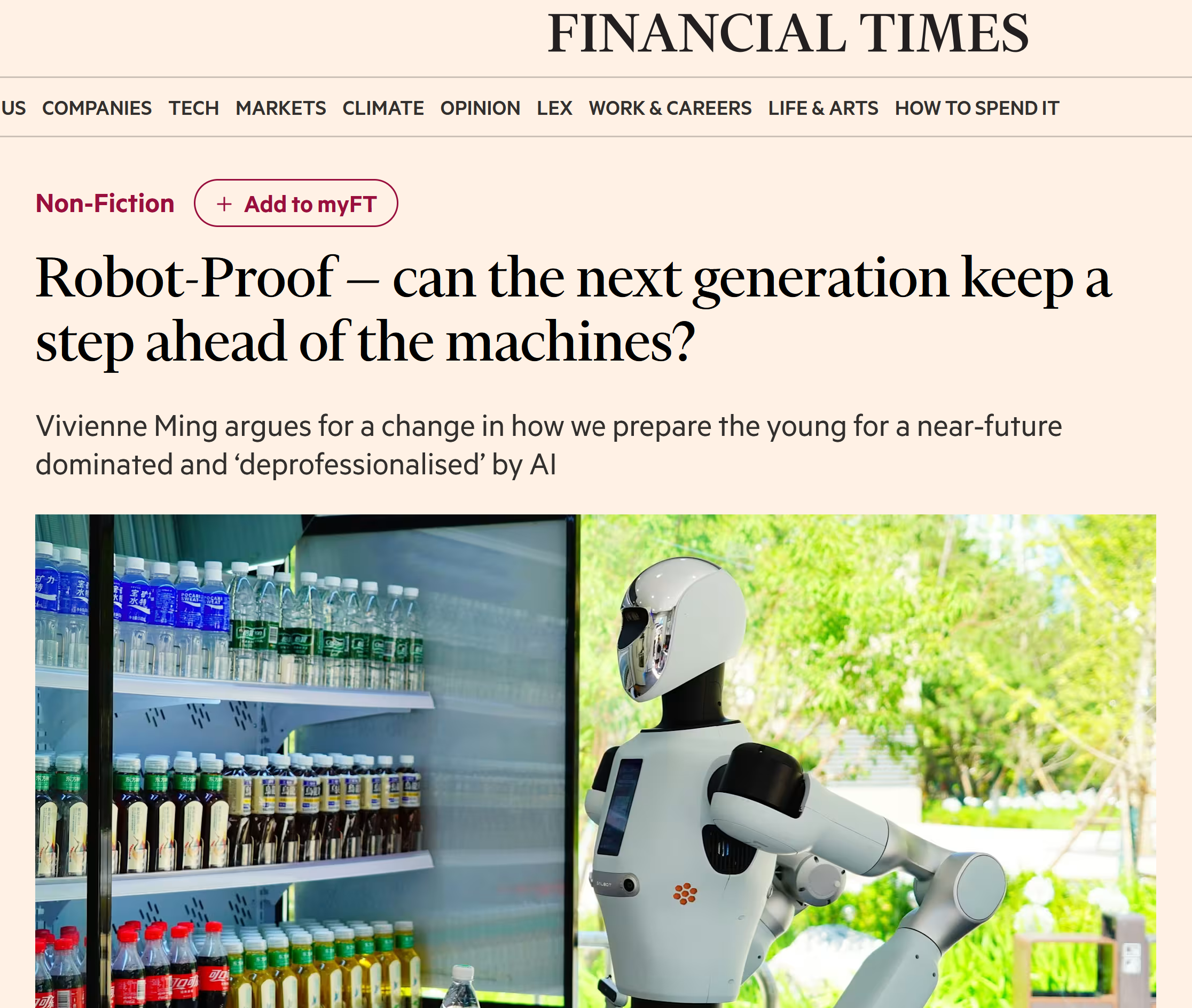
The FT's review of my book is trending on their site right now. The WSJ is does an interactive feature this weekend. I wish my publisher hadn't made we take out all of the weird stuff. Good or bad, I'm genuinely proud of my little book (and it's residual weirdness).
I had a blast talking with the AlchemistX Innovators Inside Podcast. We covered #AI, #innovation, and what actually matters in a world where machines are getting very good at answering well-posed problems.
Why does the future belong to people who can explore the unknown?
Why are most organizations still selling AI as an efficiency tool instead of an augmentation tool?
Why should the best systems make us better when we turn them off, not just more dependent while we are using them?
We also talked about productive failure, hybrid intelligence, and why human plus AI is often far more interesting than either one alone. It’s my whole book 𝑹𝒐𝒃𝒐𝒕-𝑷𝒓𝒐𝒐𝒇 in a podcast…but without the heartwarming stories or filthy jokes.
If you care about how people learn, how leaders build real innovation cultures, and how to use AI without becoming shallower in the process. Enjoy this one!
Listen to the full episode here: https://bit.ly/4eu29Pn
SciFi, Fantasy, & Me
I want to double down on 𝑻𝒉𝒆 𝑾𝒆𝒔𝒕 𝑷𝒂𝒔𝒔𝒂𝒈𝒆. Read it!
Also, what is going on in 𝑺𝒑𝒊𝒅𝒆𝒓-𝑵𝒐𝒊𝒓. I need to know.
Stage & Screen
- April 13, Online: Ethical Tech, Realist Management
- April 14, Seattle: Ill be keynoting at the AACSB Business School Conference.
- April 15, NYC: It's a public "book reading" for Robot-Proof at P&T Knitwear.
- April 16, NYC: A private event in Brooklyn. The setting is boxing, topic is AI, but I'll make it about us.
- April 16, NYC: Yes, its a busy few days in NYC. This time I'm joining The Ethical Tech Project for a fireside chat.
- April 16, Paraguay: More fun with Singularity University.
- May 12, Online: I'll be reading from Robot-Proof for the The Library Speakers Consortium.
- May 12, SF: We'll talk about collective intelligence, the neuroscience of trust, and how dumb I have to be to be launching my 13th company.
- May 14, Miami: TEDxMiami
- June 9-10, London: London Tech Week!
- June 11, Luxembourg: How Europe (and even some of it smallest states) compete and grow in a trade environment dominated by zero-sum leaders
- June 12, Denver: GlobalMindEd
- June 18, Stockholm: The Smartest Thing on the Planet: Hybrid Intelligence
- October, Toronto: The Future of Work...in the Future