Disorder Keeps Us Stable
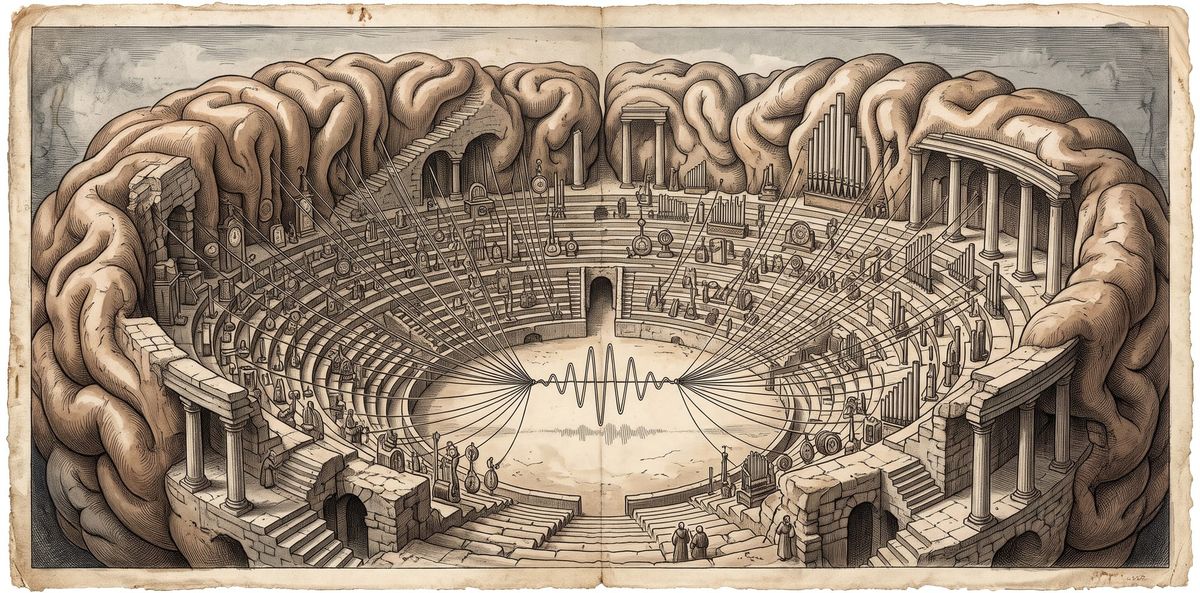
How does a messy, decentralized collection of specialists ever agree on anything? If you ask a management consultant, they will tell you to standardize the workers, eliminate redundant communication, and put a decisive executive at the top of the org chart. For a long time, neuroscientists and psychologists projected that exact same tidy bureaucracy onto the human brain. We imagined that sensory nerves efficiently package up the outside world, hand the data up a (largely) one-way chain of command, and wait for an "executive" at the top of the cortex to issue a ruling.
There is just one, minor problem with that story. When you look inside a living brain, there is no boss, the parts aren't standardized, and the departments never stop talking over each other. [1] As the 3 remarkable new papers we’ll review this week reveal, what looks like biological messiness—quirky diversity among cells, constant back-and-forth chatter, and neurons repeating the same message to their neighbors—is actually a masterwork of collective intelligence.
[1] For too long, when theorizing about the brain we scientists asked ourselves, “What would an engineer build?”, …or worse, an MBA. It turns out ecosystems, economies, cultures, and creatures have very little in common with either.
Research Roundup
Stability Is An Outcome, Not An Input
𝐒𝐭𝐚𝐛𝐢𝐥𝐢𝐭𝐲 𝐈𝐬 𝐀𝐧 𝐎𝐮𝐭𝐜𝐨𝐦𝐞, 𝐍𝐨𝐭 𝐀𝐧 𝐈𝐧𝐩𝐮𝐭. Engineering strives for stability, modularity, and uniformity. So why are natural complex systems, from cortical neural networks to ecological food webs, so relentlessly heterogeneous and downright messy?
A new landmark Science paper proves that the classic "heterogeneity causes instability" rule was actually a mathematical mirage—an artifact of researchers simplifying complex dynamics down to 1 dimension just to make the equations solvable on paper. [1]
When the authors analyzed realistic networks where individual nodes have higher-dimensional internal degrees of freedom or nonreciprocal interactions [2], the rules completely invert: both heterogeneity and network disorder actively enhance the stability. Even when parameters are randomly disordered across nodes, that diversity dampens runaway resonances and stabilizes the system across neural, power-grid, and ecological networks.
Messiness and disorder are not liabilities that the brain has to overcome; they are foundational structural resources that prevent complex systems from tearing themselves apart…
…complex systems like societies. [3]
[1] Yielding Hermitian Jacobians, as we all know from everyday life.
[2] Yielding non-Hermitian Jacobians, natch.
[3] I loved this paper as this is a major thesis of one of my upcoming books, 𝑴𝒆𝒔𝒔𝒚 𝑯𝒖𝒎𝒂𝒏 𝑷𝒓𝒐𝒃𝒍𝒆𝒎𝒔.
Cortical Harmony
𝐂𝐨𝐫𝐭𝐢𝐜𝐚𝐥 𝐇𝐚𝐫𝐦𝐨𝐧𝐲. Your cortex is divided into dozens of specialized neighborhoods. For example, differing regions of your visual system each look at a different piece of the puzzle—one tracks fine edges (V1), another tracks motion or broader context (LM). [1] When you glance at a shadowy shape in the woods, how do these different neighborhoods reconcile their conflicting first impressions to agree on whether you’re looking at a bear or a bush?
The answer comes from simultaneously recording from both lower and higher visual areas (in mice, in this particular experiment) while using targeted light pulses to nudge neural activity and watch how the regions responded to each other.
The two-way (reciprocal) wiring between V1 and LM acts as a self-sorting consensus engine. The circuit is tuned so that when the lower and higher regions hit on activity patterns that agree with each other, the two-way loop acts like a tuning fork, resonating with the shared signal and dampening the discordant. The dynamics drive compatible interpretations to linger and grow stronger. When the two regions produce conflicting interpretations, the loop rapidly starves the signals, causing the disagreement to die out in milliseconds.
The brain doesn't need a central CEO to adjudicate every dispute; its two-way connections are physically wired so that truth echoes and contradictions evaporate.
[1] This is a wild oversimplification, but the spirit is sufficient.
Efficient Redundancy
At the outer edges of our senses—like the ear and the eye—the nervous system is a marvel of "efficient coding", packing as much raw information about the natural world as possible into every nerve fiber with minimal overlap. For decades, many assumed that when we learn a new skill, the rest of the cortex should do the same thing: make neurons more independent so they stop repeating to each other: decorrelation.
But decorrelation is a mechanism, not a principal [1], and so some clever researchers recorded activity across a region of visual cortex (area V4) over several weeks as monkeys learned to master a tricky visual judgment task.
As the animals became experts, their cortical neurons didn't become more decorrelated; they became dramatically more redundant. At the start of training, each neuron fired mostly on its own, but by the time the monkeys mastered the task, roughly half of every neuron’s task information was shared with its neighbors.
Once raw sensory data is inside the brain, the goal shifts from capturing the world to interpreting it. Through top-down feedback loops, the brain’s best global guess about what it is seeing is broadcast back down into the sensory neurons, aligning the whole neighborhood around a shared conviction. This purpose, generative inference, aligns with the mathematical principle of efficient coding (maximizing mutual information between perception and action) even as it violates that surface details (decorrelation).
If all of this seems rather scientific and abstract for you, then just remember this principle: in learning how, don’t skip why.
[1] As someone who pushed a paper titled, “Efficient auditory coding” (Nature, 2006), I always saw decorrelation as a contextual outcome, not a coding principle. So, what principal principle is a principled brain supposed to follow that doesn’t violate the mathematical foundations of an efficient coding principle? For those who care about this sort of thing, even a simplistic, 0-noise framing information theory does not predict that neurons will be decorrelated. It predicts that they will be independent. On a related note, the mathematical principle underlying PCA is not “dimensionality reduction”.
Takeaway
Taken together, these 3 studies tell a story that every teacher, writer, and leader should tape to their wall: efficiency and consensus require different architectures.
At the front door of perception, you want maximum variety and minimum overlap—diverse sensory specialists capturing every nuance of the world without wasting energy repeating each other. That is why disorder and diversity are so vital: a uniform system is both blind to nuance and brittle under stress.
But once all those diverse perspectives are in the room, how do you turn a cacophony of local clues into a single, confident decision? Neither by issuing a top-down decree nor by keeping everyone in isolated silos. Messy systems like the brain solve the problem through reciprocal resonance. Specialized regions interact in tight, multi-way loops where compatible evidence echoes and Incompatible noise dies away. And as that negotiation discovers a coherent story, it broadcasts that conclusion back across the entire network—trading away individual independence so the whole population can lock in a shared, high-confidence consensus.
These are how real, messy systems outperform the best we can engineer. Whether you are trying to get a classroom of 8-year-olds to grasp a new concept, a cross-functional company to ship a product, or 100 billion neurons to recognize a friend's face in the rain, the secret is the same. [2] Protect the weirdness of your specialists, wire them into multi-way conversations where good ideas can echo, and let the consensus emerge from the loop.
[1] Side benefit: when V1 and V4 have a disagreement about a shadow, they resolve it in 150 milliseconds without scheduling a 45-minute Zoom sync or cc'ing 17 vice presidents.
Media Mentions
?
SciFi, Fantasy, & Me
I’ve noticed an efficiency to John Scalzi’s novels: he does with his stories what he sets out to do and doesn't let world building lure him away. I saw this clearly in When the Moon Hits Your Eye, and now again in Monsters of Ohio. True to the title: it is set in Ohio; there are monsters; there are horrible tentacled things. Within that, Scalzi stays focused on what matters to him, just as he did with lunar cheese.
He can clearly do world building—The Collapsing Empire and , of course, Old Man’s War—but he clearly has a different purpose for his one off novels. I enjoy the contrast.
Stage & Screen
- Dec 7-8 NYC: The Kennedy Human Rights Center Gala!
- Jan 18, Davos: A whole week as an "Invited Expert"–will I even survive? Will they?
- Feb 3, Helsinki: it's still fingers crossed!
- Feb 8, SF: Another Singularity University masterclass!
- Feb 23, Orlando: Training 2027
- Mar 3, Curacao: The date is still in flux but they are working hard to make it happen.
- Mar 11, London: Keynoting for the Big Ideas Summit!
- It's Invited Academic talk Season: Mar 15, Penn St; Mar 24, Monmouth;Apr 4, UMass
- Apr 21, Singularity: More master classing
- May 4, Sao Paulo: more to come
- Upcoming: May 13, NYC; Jun 1, Chicago; Jun 29, UK; and Sep 10...Schenectady?!?