Language Models Are Erasing Our Weirdness
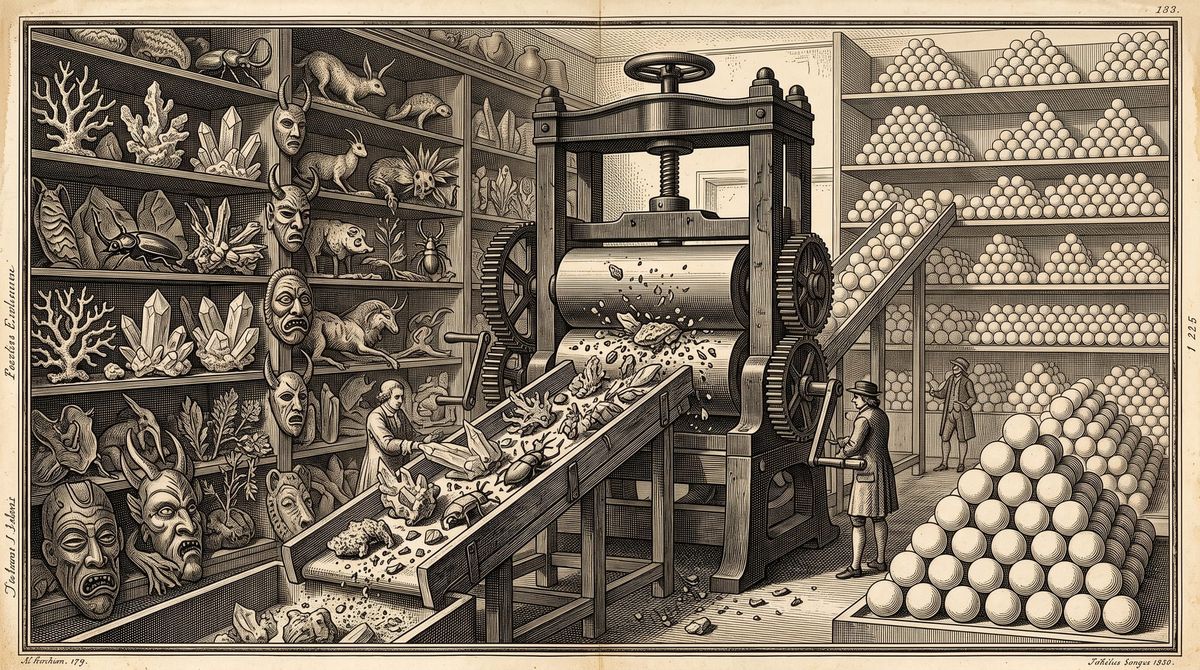
Collective intelligence depends on a mathematical requirement that most people find socially exhausting: decorrelated error. A crowd is only wiser than its smartest member if the individuals in that crowd are weird in different ways—bringing idiosyncratic priors, culturally distinct metaphors, and orthogonal blind spots to the table.
For a 100,000 years, human geography and embodied experience naturally protected that variance. Today, we are running a planetary-scale experiment in variance collapse. By routing our brainstorming, our prose, and our conceptual representations through a tiny handful of foundation models trained via the same next-token objectives and smoothed over by the same human-preference raters, we are building an epistemic centrifuge—one that systematically spins out the weird, the local, and the idiosyncratic. Human thought is being purified into the dead center of the statistical distribution. [1]
[1] A dystopian future might not be a boot stamping on a human face forever; it might be a helpful chat window gently suggesting that everything you might be better if it was statistically indistinguishable from everyone else.
Research Roundup
Welcome to the Artificial Hivemind [1]
When you ask an LLM an open-ended creative question, it feels like you are having a private, bespoke brainstorming session. You’re in good company—everyone else is having the same feeling about that same conversation.
INFINITY-CHAT is a benchmark of 26,000 real-world, open-ended user queries spanning 17 subcategories (such as ideation, creative writing, and counterfactuals), paired with 31,250 human annotations. A new analysis put more than 25 leading open- and closed-weight language models through INFINIY-CHAT’s improv exercise.
Contrary to the idea that LLM’s a stochastic and unpredictable, the results expose a massive "Artificial Hivemind" effect driven by 2 layers of mode collapse:
- severe intra-model repetition (the same model giving the same idea across separate runs) and
- even more striking inter-model homogeneity (completely different model families from rival labs converging on nearly identical outputs).
Prompted 50 times each to write a metaphor about time, 25 different LLMs overwhelmingly generated variations of "Time is a river" or "Time is a weaver".
Furthermore, state-of-the-art reward models and LLM-as-a-judge pipelines are poorly calibrated to evaluate responses that spark genuine, idiosyncratic disagreement among human raters—meaning our current fine-tuning and alignment pipelines are mathematically penalizing the exact variance required for breakthrough creativity.
[1] Who new the machine would be so cheerfully helpful.
Fitter Happier
Language is not a neutral pipe for transferring facts; the structural complexity and lexical quirks of how we write encode our psychological states, cognitive styles, and cultural backgrounds. Some of my favorite past research projects have involved language analysis to understand differences between people.
So, what happens to human expression when people use LLMs to polish, edit, or co-write their text?
Three studies spanning 7 datasets and more than 880,000 texts across multiple domains show that LLM-assisted rewrites faithfully preserved the core factual content of the authors' messages [1]. But on theme for the research I’m sharing this week, agentic polishing reduces writing-complexity variance by a significant and meaningful 21–50% across all datasets and models.
Worse, this homogenization isn’t neutral. The models systematically amplified linguistic patterns associated with dominant demographic norms while suppressing minority and non-standard stylistic markers. [2]
Trading away syntactic idiosyncrasy for frictionless "professional" fluency is quietly erasing the psychological and cultural diagnostic signals embedded in human text…and human minds.
[1] As someone that is net positive on agentic systems but who regularly writes rarified subjects and quirky ways, that is definitely not a universal truth.
[2] I completely understand the periods a subposed to always occur inside closing quotation marks that end sentences, but I don’t care! If there wasn’t a period in what I am quoting, I will not lie about it! [3]
[3] Gemini is complaining about 4 separate parts of that sentence.
Once in a Lifetime
𝐎𝐧𝐜𝐞 𝐢𝐧 𝐚 𝐋𝐢𝐟𝐞𝐭𝐢𝐦𝐞. For decades, cognitive scientists have debated whether human concepts are universal by comparing word embeddings across different languages. [1] But what if words themselves are a compression algorithm that hides how differently we actually think? To answer this, let’s explore an astonishing dataset of 2.6 billion human-made sketches of common everyday concepts drawn by people across 236 countries and territories.
The geometry of visual sketch embeddings and multilingual text embeddings diverges sharply. Upon it’s utterance, language collapses concepts like "chair", "bread", or "pliers" into tidy conventions, while visual imagination unfolds into multiple distinct exemplars, especially for objects involving haptic interaction with the body.
Cross-cultural similarities derived from how people draw concepts in the dataset align 45% more closely with established sociological and cultural distances than text-based measures do. Words are low-bandwidth social contracts evolved to smooth over our differences and facilitate coordination. Our embodied mental representations are vastly richer and more culturally diverse than any text-only corpus can capture.
[1] Yes, for decades. Did you think word2vec invented embeddings?
Takeaway
As the 2.6-billion-sketch study demonstrates, human language is already a lossy compression. To talk to our neighbors, we take high-dimensional, embodied, culturally specific mental models and squeeze them into standardized lexical tokens, throwing away nearly half of our cultural and sensorimotor variance in the process.
Now companies have scraped that already-flattened linguistic residue off the internet to train LLMs. And as the other 2 papers demonstrate, those products in turn apply a brutal second-order compression pass. Through reinforcement learning from human feedback (which marginalizes over raters and rewards the safest modal response), LLMs shave another 21–50% off our linguistic variance and collapse open-ended ideation into a single, cross-model "Artificial Hivemind" where time is always a river and every band is named Neon Velvet.
This is a non-ergodic crisis for human innovation. Discovery does not happen at the centroid of the distribution; it happens in the long tails, where an outsider's weird, culturally specific mental model collides with orthodoxy. If we use agents as our universal cognitive interface, pre-filtering our brainstorms and polishing our prose, we are systematically amputating the tails of the human distribution.
You’ll miss the weird when it’s gone.
Media Mentions
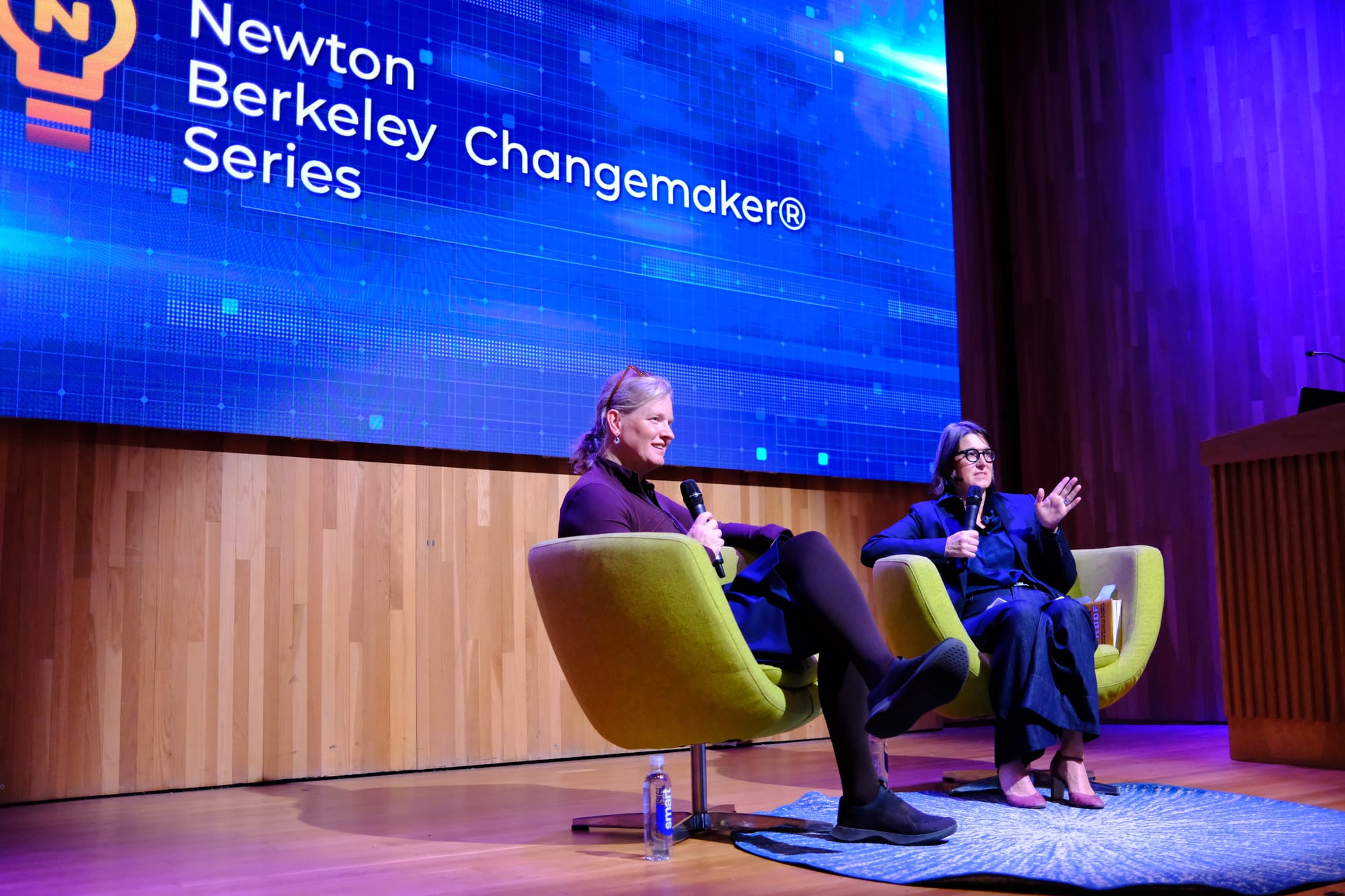
Berkeley Changmaking!
SciFi, Fantasy, & Me
For the tyranny and beauty of language, pair China Miéville’s Embassytown with Arkady Martine’s A Memory Called Empire. Miéville imagines a species for whom language and literal physical reality are so tightly bound that a single human metaphor acts like a hallucinogenic narcotic. Martine sees language as the ultimate imperial operating system—a literary and poetic tradition so seductive and totalizing that simply learning to speak it fluently colonizes your mind from the inside out, smoothing away your outsider weirdness until you can no longer think a thought the Empire didn’t write for you first.
Stage & Screen
- October 29, San Diego: ...or maybe I'll be at UCSD for a book talk.
- November 19, Bangkok: Finally back in East Asia!
- Anyone in Australia want to piggyback on that trip?
- December 7-8 NYC: The Kennedy Human Rights Center Gala!
- Already next year:
- January 18 Davos: maybe
- February 3, Helsinki
- 2/8, SF
- 2/23, Orlando
- 3/3 Curicao
- 3/11 Toronto
- 3/11 London
- 3/15 Penn St
- 3/24 NYC
- 4/1 UMass
- 5/4 Sao Paulo
- 5/7 San Diego
- 5/13 NYC
- 6/1 Chicago
- 6/29, UK