Measuring the Neural Symphony
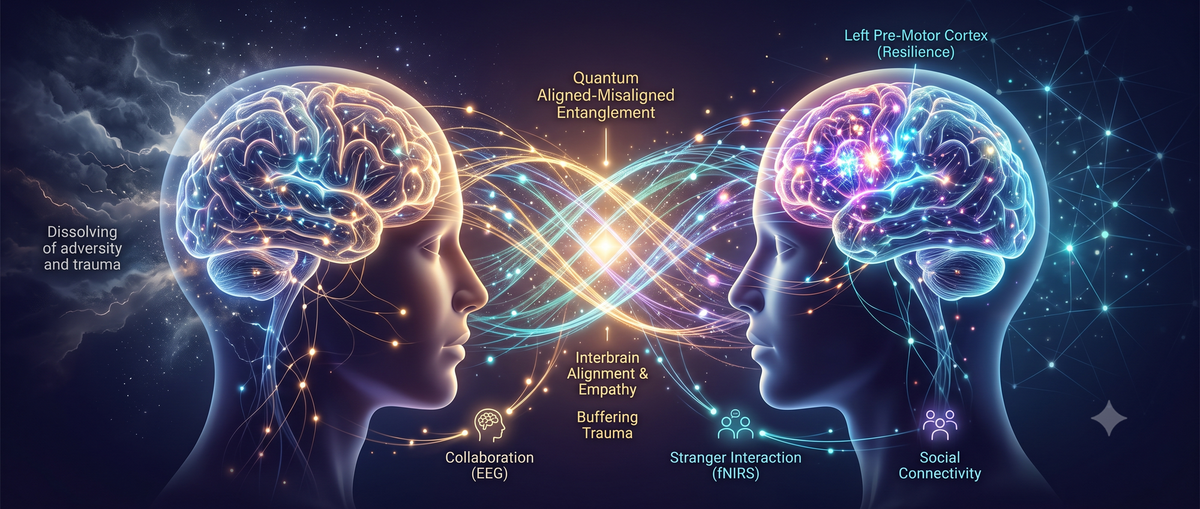
We’re focusing on the emerging field of hyperscanning—recording brain activity from multiple individuals simultaneously—to understand the neurobiological underpinnings of shared learning, collaborative memory, and trauma recovery.
Research Roundup
Interbrain Beta Coupling
There’s new evidence that when a good teacher connects with a student their brains sync…literally.
Over 3 semesters of math and language classes, students and teachers wore mobile EEG hyperscanning headsets. Researchers recorded patterns of activity rising and falling over time looking for evidence of coupling between teachers and successful students.
Dynamic dynamic increases in student-teacher brain synchronization, particularly 23-30 Hz beta band activity, predict subsequent academic improvements in both math and language classes. Importantly, the single isn’t just a loose rise and fall of activity but dynamic moment-to-moment alignment of neural oscillations.
The beta is important as it suggests coupling in executive control and arousal. Students and teachers were matching their focus on the educational material
This could be an amazing tool for teachers themselves to learn how to sync with their students using the hyperscanning to reveal what is working and what isn’t. And if it works for teachers…
Imagine managers and coworkers able to literally see when their interactions produce interbrain coupling, when they are truly “in sync” with one another. Perspective taking, a strong predictor of positive life outcomes, might open to enhanced neural feedback training.
It feels a bit science fiction to think about these possibilities, but with their enormous complexity, brains border on the science fictional.
|Aligned> Collaboration
When are two people like two photons? When they are coupled, they share information [1].
A fascinating new study explored interbrain connectivity: how our brains align when we learn and remember things together. Historically, it's been tough to prove true mental connection; traditional models couldn't tell if two brains were genuinely collaborating or just reacting to the same external stimuli at the same time.
To solve this, this study used dual-brain EEG “dual-brain…EEG hyperscanning” and a quantum-inspired entanglement model to map the precise dynamics between pairs of collaborators. When people collaborate, their brains show a significantly higher probability of entering truly "aligned" states compared to working independently.
Further, when pairs underwent empathy-enhancement training, their brain activity shifted toward socioemotional regions. This empathic tuning actually reshaped how their brains connected and directly predicted how well they retrieved the memory later.
Quantum framing isn't just for particles anymore—whenever you feel like you and a teammate are on the same wavelength, perhaps it is more accurate to say that you are in superposition.
Our brains don't just passively tune into the same frequency when we cooperate. Interbrain connectivity is highly context-sensitive, dynamically evolving with how we engage, and deeply intertwined with empathy and perspective taking.
[1] This is not the Wildean witticism I’d hoped to conjure. Just imagine I’d somehow used spin superposition to imply simultaneous missionary, 69, and dirty cowgirl.
Finding Strength in Others
Human beings are deeply social creatures [1], In fact, our ability to "sync" with others actually serves as a shield against trauma.
In my 3rd interbrain synchrony study of the week [2], researchers explored if they could predict how well someone copes with severe adversity based on a truly unique and terrible, real-world dataset.
Prior to the tragic terrorist attacks in Israel on October 7th, 2023, 98 participants had their brain activity tracked using fNIRS imaging while having a casual conversation with a stranger. Following the attacks, researchers checked back in with the participants to measure their trauma exposure and subsequent symptoms of PTSD and depression.
While higher exposure to trauma naturally led to increased psychological distress, the researchers discovered a powerful buffer: individuals who showed higher interbrain synchrony with a stranger before the crisis reported significantly fewer PTSD and depression symptoms after, even if they experienced high exposure to the traumatic events.
This protective effect was most prominent in the left pre-motor cortex, a region of the brain involved in the understanding, mirroring, and adapting to the actions and emotions of others.
The study suggests that spontaneous brain-to-brain synchrony—a stronger biological predisposition for social connection—directly translates to better psychological defense mechanisms.
Social connection isn't just a comforting concept; it might well be structurally protective. Our capacity to get "in sync" with the people around us might just be one of the most powerful tools our brains have for surviving life's darkest moments.
[1] Yes, even me, a complete lack of social instincts notwithstanding [3].
[2] The phenomenon where 2 peoples' brainwaves physically synchronize during social interaction.
[3] The man-bear-pig of words.
Media Mentions
At long last, a working paper/preprint of my paper "Human Capital, Not Model Benchmarks, Predicts Hybrid Intelligence in Forecasting" at https://arxiv.org/abs/2607.02467
I had a fun conversation with William Gadea. Here's the video:
SciFi, Fantasy, & Me
The Subtle Art of Folding Space is not hard scifi but it is twisty ideas of comfort food and multiversal physics in superposition. I can understand why it won awards even while confounding many readers. I wouldn’t be in the mood for this every day, but it was tasty and twisty to noodle on.
Stage & Screen
- July 7, MIT: Today I'm giving the keynote for the MIT App Inventor Global Education Summit taking place this year at MIT CSAIL.
- July 8, NYC: Tomorrow its a book talk for Robot-Proof at the Harvard Club...how swanky!
- July 14, SF: AI+ education means...what? We discuss at WESTED's annual board retreat.
- July 14, Napa: Deep thought about AI and Society.
- September 15, Amsterdam: How might AI change the world of investing?
- September 15, SF: Innovation Day with INSEAD!
- September 16, DC: AI and education–beyond dreams and dread.
- September 19, Phoenix: I'm giving the keynote for the Association of Science & Technology Centers annual conference.
- September 21, Stanford: We're still working on the details, but hopefully I'll be talking about my research on machine learning and neurodiversity for Stanford's Neurodiversity Project.
- September 24, UC Berkeley: It's my annual Berkeley Change-makers Lecture!
- September 24, NYC: Culture Shifting Deal Making Summit
- September 29, Cincinnati: Still baking...
- September 30, Irvine: Hybrid Intelligence for innovation!
- October 6, SF: UCSD Alumni Association
- October 6, SF: Giving a talk at the Draper Richards Kaplan Foundation
- October 21-23, Warsaw: So much good stuff is in the works for my first visit to Poland (and maybe time in Germany as well!)
- October, Toronto: The Future of Work...in the Future
- November 19, NYC: Secrets in the dark!