Predicting Disaster: The Microstructure of Prediction Markets

This week we explore the rapidly growing ecosystem of prediction markets (e.g., Polymarket, Kalshi), analyzing who actually profits, the persistent cognitive biases of retail traders, and the mechanisms driving wealth transfer.
Research Roundup
The 1% of Polymarket
Prediction markets get praised for their accuracy—the "wisdom of crowds" made liquid. Accuracy at the market level tells you little about what happens to the individual people inside it. Let’s open up Polymarket, with the help of a new paper, and take a look inside.
Using an enormous dataset (588 million trades representing $67 billion in volume) reveals that trading gains are wildly concentrated: the top 1% of users capture 76.5% of all profits. But the mechanism isn’t superior forecasting, just better execution.
Winners overwhelmingly make money by providing liquidity with limit orders, patiently posting prices and waiting, while losers take liquidity with market orders, demanding immediate execution and paying for the privilege. The successful traders on Polymarket look less like oracles and more like old-fashioned market makers, quietly collecting a toll from impatient retail traders.
The romantic story many influencers tell about prediction markets is considerably messier in practice. The crowd may be wise in aggregate, but that “wisdom” is subsidized by a large population of individually unwise participants. The market's accuracy and the market's economy are two different things.
The Polymarket paper says insider trading probably isn't the story there. But before we get too comfortable, consider a delightfully uncomfortable finding from an unrelated corner of finance. Another recent paper scraped over 100,000 Facebook profiles and their 35 million friends to identify concealed social ties between mutual fund managers and corporate officers—friendships that don't show up in the usual alumni or boardroom databases.
Funds with these hidden connections earn abnormal returns of roughly 135 basis points per month, over 16% annualized alpha, concentrated suspiciously around earnings and M&A announcements, and growing with the degree of concealment.
The more hidden the friendship, the better the returns. There's a technical term for this kind of edge. I propose we call it “asshole alpha”.
Worse Odds Than a Slot Machine (and Paying Them Voluntarily)
Slot machines on the Las Vegas Strip return about 93 cents on the dollar, which is widely considered some of the worst deals in gambling. So here is a genuinely humbling statistic: on Kalshi, a CFTC-regulated prediction market, traders have poured money into longshot contracts with historical returns as low as 43 cents on the dollar. Thousands of people are voluntarily accepting odds a casino would be embarrassed to offer.
This new study, built on 72.1 million Kalshi trades ($18.26 billion in volume), documents a classic "longshot bias" (the tendency to overpay for low-probability outcomes) and then does something more interesting: it decomposes returns by market role. The result is a persistent, structural wealth transfer.
Impulsive Takers (traders who accept posted prices) systematically overpay for affirmative "YES" outcomes. Makers (traders who post prices) capture what the authors call an "Optimism Tax" simply by selling into this biased flow.
The effect is strongest in high-engagement categories like Sports and Entertainment, where people are betting on narratives they want to be true [1]. In low-engagement categories like Finance, prices approach textbook efficiency. [2]
Prediction markets are efficient not because participants are rational, but because there's a mechanism for harvesting irrationality. The market's famous accuracy isn't a free gift of crowd wisdom; it's manufactured, trade by trade, by disciplined makers profiting off hopeful takers. The price is right precisely because someone is being systematically wrong, and someone else is being paid to correct them. If you've ever bought a 5-cent "YES" on your team making the playoffs, congratulations: you are the dumb money that funds the wisdom.
[1] Who could have guessed that people betting on which Kardashian will marry next or how many times Elon Musk tweets this would be bad at pricing securities?
[2] Having run an experiment using questions off of Polymarket, I was shocked at the relatively few questions of any societal importance that had meaningful sums being bet. Unwise crowds lose money on celebrity gossip. The invisible hand of the market is masturbating.
Being Right Is Not a Business Model
Here's a finding that should be framed and hung above every retail trading app: retail traders correctly forecast asset price direction…and still lose money.
Using 222 million prediction market trades (a setting with the lovely property that every contract has an observable terminal payoff: it resolves to $1 or $0, no ambiguity), the authors decompose each trader's returns into 2 components.
- The insight component: did you pick the right side?
- The execution component: did you get a favorable price?
Traders with well above-random forecasting accuracy earn negative returns because they arrive late and pay unfavorable prices. Meanwhile, traders with near-random accuracy—many purely automated—turn a profit purely through superior execution.
The two skills are nearly orthogonal (correlation of roughly 0.13), and both are consistent over time across traders. The single biggest separator between winners and losers isn't insight—it’s execution: automated traders pay 2.52 cents less per contract than casual traders, and that execution gap alone accounts for profit across trader types.
We like to think markets reward knowledge. This paper suggests they primarily reward plumbing. By the time a casual trader has read the news, formed a (correct!) view, and tapped "buy," the price has already moved to absorb their insight…and then some. Opinionless bots pocket the difference. Being right and making money are, as the authors put it, not the same thing.
Is this what markets are supposed to reward? The founding pitch for prediction markets was information aggregation: incentivize people to reveal what they know. Instead, the reliable profits flow to whoever has the lowest latency and the most patient order book. The people actually contributing the information pay for the privilege. The forecast improves; the forecasters get skinned.
Somewhere, an economist is calling this "incentive-compatible". The rest of us might call it a tax.
Media Mentions
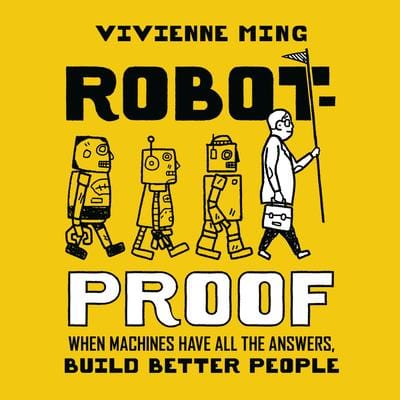
If you didn’t see, the audiobook edition of 𝑹𝒐𝒃𝒐𝒕-𝑷𝒓𝒐𝒐𝒇: 𝑾𝒉𝒆𝒏 𝑴𝒂𝒄𝒉𝒊𝒏𝒆𝒔 𝑯𝒂𝒗𝒆 𝑨𝒍𝒍 𝑻𝒉𝒆 𝑨𝒏𝒔𝒘𝒆𝒓𝒔, 𝑩𝒖𝒊𝒍𝒅 𝑩𝒆𝒕𝒕𝒆𝒓 𝑷𝒆𝒐𝒑𝒍𝒆 is out now, narrated by Kristen Kallen-Keck. It's not a book about machine learning. It's a book about people: what human qualities go up in value as machine become more intelligent…how how to grow them.
🎧 Go check out the audiobook on Audible or Libro.fm
I had a fun conversation with William Gadea. Here's the video:
SciFi, Fantasy, & Me
This week's pick will surprise exactly no one who has read this section before: Adrian Tchaikovsky’s newest, Children of Strife. I enjoy nearly everything the man writes—sci-fi, fantasy, short stories…whatever genre he's exploring that month—and so a fourth Children of Time book was always going to end up in my hands.
Honestly, it's the weakest entry in the series. The first book rewired my brain, and Strife doesn't quite reach that bar—the plot sags in it’s effort to cover so much history, and a few of the characters are unlikable in ways that feel like a slog.
But "weakest Children of Time book" is still a high compliment, because the big ideas are all here and gloriously weird: we finally see the uplifted mantis shrimp, explore a terraformed planet turned living computer, and three timelines colliding across millennia. And as always with this series, what I love most is watching very human foibles—pettiness, bitterness, wounded pride, wounded souls, and the itch to play god—rub up against one another at civilizational scale. The species change; the flaws don't. That's the joke and the tragedy.
Stage & Screen
- July 14, SF: AI+ education means...what? We discuss at WESTED's annual board retreat.
- July 24, Napa: Deep thought about AI and Society.
- September 15, Amsterdam: How might AI change the world of investing?
- September 15, SF: Innovation Day with INSEAD!
- September 16, DC: AI and education–beyond dreams and dread.
- September 19, Phoenix: I'm giving the keynote for the Association of Science & Technology Centers annual conference.
- September 21, Stanford: We're still working on the details, but hopefully I'll be talking about my research on machine learning and neurodiversity for Stanford's Neurodiversity Project.
- September 24, UC Berkeley: It's my annual Berkeley Change-makers Lecture!
- September 24, NYC: Culture Shifting Deal Making Summit
- September 29, Cincinnati: Still baking...
- September 30, Irvine: Hybrid Intelligence for innovation!
- October 6, SF: UCSD Alumni Association
- October 6, SF: Giving a talk at the Draper Richards Kaplan Foundation
- October 21-23, Warsaw: So much good stuff is in the works for my first visit to Poland (and maybe time in Germany as well!)
- October, Toronto: The Future of Work...in the Future
- November 19, NYC: Secrets in the dark!