The Resilience Wind Tunnel
Research Roundup
The Biology of Hope
Can your outlook on life actually help you live longer? A major new study in PNAS not only says “yes”, the effect size is enormous.
Across thousands of adults over decades, higher optimism is associated with an 11-15% longer lifespan and significantly greater odds of "exceptional longevity" (living past 85).
Optimism's association with healthy lives holds true even after controlling for health behaviors like diet, smoking, and exercise. It isn't just that happy people jog more; it’s that an optimistic mindset appears to be a direct biological buffer against aging.
This provides powerful real-world validation for my new simulation paper on resilience (which I discuss in the paid newsletter). Across thousands of simulated lives (simulations based on papers like this one), resilience training causally reduced mortality risk over a lifetime.
The takeaway? The foundational skills of meta-learning aren't 'soft', or just about a better job. They are a biological lever for a longer life [1].
[1] Though I admit, even optimism can be unhealthy when taken to an extreme: “Don’t jump! You’ll never make it.”
“Not with that attitude I won’t…AAAHHHHhhhhhhhhhh...splat.”
Adversity is a Technology
We often view childhood adversity solely through a "deficit model"—assuming it simply breaks the brain. But ignoring the harms of childhood adversity is also flawed. What happens when we “integrate deficit and adaptation frameworks” to understand the effects of adversity?
https://psycnet.apa.org/fulltext/2026-57921-001.html
Applying cognitive model (drift diffusion) to detailed behavioral data reveals that exposure to childhood threat doesn't just impair executive function across the board. Instead, it specifically alters processing speed and information accumulation.
In a high-threat environment, the brain adapts by prioritizing speed over precision. It’s not "broken"; it’s optimized for a dangerous world. This is a crucial distinction for anyone interested in human potential.
Rather than either pitying or shunning those with adverse backgrounds, we can recognize that they have adapted to their context. The goal of building foundation skills later in life isn't to "fix" them, but to give them the meta-learning tools to switch gears—to use that speed when necessary, but to engage slow, deliberative agency when building a future.
Adversity and technology have a similar dynamic with human capital: their impacts on humans depend on how humans’ engage with them.
The Zombie Switch
Why do people spiral during a crisis? Why is it so hard to "pull yourself up by your bootstraps" when you are drowning in stress? Chronic stress literally disconnects your agency.
In mice (who have depressingly similar stress circuits to us), stress atrophies the connection between the amygdala and the goal-directed parts of the striatum that “underlie adaptive agency”. Simultaneously, it strengthens a separate pathway that mediates habit formation.
In other words, stress flips a switch in your brain from "Thoughtful Agent" to "Habit Machine." You stop making decisions based on future goals and start reacting based on rigid, past behaviors.
This finding is the neurological "smoking gun" for the results I found in my new simulation paper. In my model, non-resilient agents who lost their jobs spiraled financially—likely because stress flipped this switch, trapping them in reactive loops.
The resilient agents, however, kept their "Agency Circuit" online. Resilience isn't just about feeling good; it's about keeping your prefrontal cortex in the driver's seat when the road gets rough.
Media Mentions
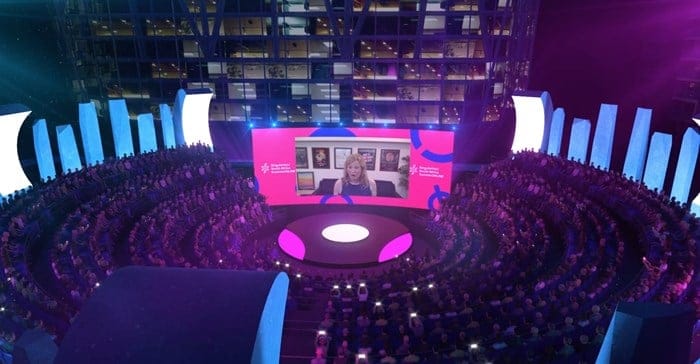
Someone shared this image with me of a remote talk I gave in South Africa. As far I I could tell, I was all by myself in my studio in Berkeley. I had no idea how many people were watching. (Good thing I'm so charmingly mad, even when I'm alone.)
SciFi, Fantasy, & Me
Diaspora by Greg Egan (1997)
A thousand years from now, humanity has split into "fleshers", cyborgs, and "citizens"—pure software consciousness living in digital utopias. When a neutron star collision threatens the solar system, the citizens don't build ships; they email themselves across the galaxy to find answers.
If you liked the hard cognitive science of Blindsight but wanted the ideas purer, bigger, and without the vampires, this is your book. Egan explores the truly weird. Read it for the exhilarating vertigo of grasping a concept of biology and physics that is actually, properly alien.
Stage & Screen
- January 20, Davos: After all these years, they are finally allowing me to speak in Davos at the World Economic Forum.
- February 2, NYC: My latest research on neurotechnologies for cognitive health and more.
- February 10, Nashville: Shockingly, I haven't visited Nashville since I was a little kid. On this trip I'll be looking at why Tennessee and North Carolina appear to have more entrepreneurship than all over their neighboring states combined.
- March 8, LA: I'll be at UCLA talking about AI and teen mental health at the Semel Institute for Neuroscience and Human Behavior.
- March 14, Online: The book launch! Robot-Proof: When Machines Have All The Answers, Build Better People is will finally be inflicted on the world.
- Boston, NYC, DC, & Everywhere Along the Acela line: We're putting together a book tour for you! Stay tuned...
- Late March/Early April, UK & EU: Book Tour!
- March 30, Amsterdam: What else: AI and human I--together is better!
- plus London, Zurich, Basel, Copenhagen, and many other cities in development.
- April, Napa: The Neuroscience of Storytelling
- June, Stockholm: The Smartest Thing on the Planet: Hybrid Collective Intelligence
- October, Toronto: The Future of Work...in the Future