Science Needs Alien Invaders
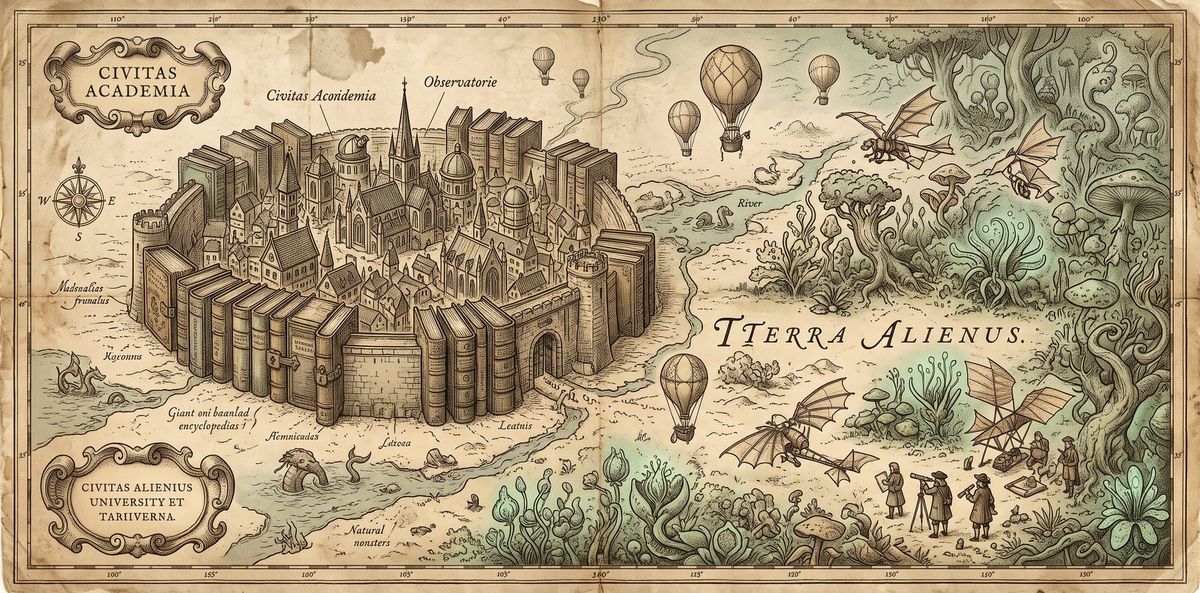
Science has an agoraphobia problem. We have organized human knowledge production into hyper-specialized guilds, each patrolling its borders with dense technical jargon, insular peer-review panels [1], and citation cartels that reward incremental confirmations of what the guild already believes. Truly new ideas must fight through these institutional constraints. Having locked researchers inside these epistemic silos, we act shocked when the rate of genuinely disruptive scientific breakthroughs plummets. [2]
The irony is that the empirical recipe for high-impact discovery is not a mystery: breakthroughs happen when outsiders carry weird tools into stagnant, foreign territory. As human fields retreat behind higher linguistic walls, a new question emerges: can we use AI not to summarize the consensus but to map the "alien space" outside it?
[1] Academic peer review was ostensibly invented to keep cranks from publishing perpetual-motion machines in the Philosophical Transactions. That is still valuable, and arXiv isn’t helping.
[2] Or worse, turning science into influencer-dominated creator culture. I see more sharing of tweet storms than original papers.
Research Roundup
Outsiders Surprise Scientific
Where does path-breaking scientific and technological innovation actually come from? What distinguishes genuinely surprising advances from expected incremental work at scale? Surprise: its surprise!
An analysis of 10s of millions of scientific papers and patents across disciplines used a hypergraph model [1] built on high-dimensional embeddings. It can both predict which combinations of research contents (e.g. article keywords) and contexts (e.g. cited journals) are expected and measure what happens when a paper violates those expectations.
"Surprising" papers—those that fuse unexpected combinations of content and disciplinary context—are disproportionately likely to become runaway hits, landing in the top 10% of all citations.
More importantly, producers of these breakthroughs rarely emerge from insiders incrementally extending their own subfield. The most impactful surprises arise from "knowledge expeditions": scientific outsiders from a distant discipline crossing borders to publish problem-solving results for a foreign audience.
Discovery is not a solo marathon run in a straight line; it is a collision of orthogonal worldviews. [2]
[1] It sounds scifi, but hypergraphs are just graphical models where an edge can connect any number of nodes at once, allowing you to model multi-way relationships instead of just pairwise ones. For example, it lets you show whole groups of friends as more than just a collection of pairs of friends.
[2] Besides, AI4Science is increasingly better at grinding incremental discovery than human labs.
Jargon Chokes Idea Diffusion
Long before I was a graduate student, cross-disciplinary integration has been the engine of breakthrough science. Yet sometimes it feels like we are talking to each other less than ever. Some economists decided to measure whether this is real and what might drive it.
Tracking the flow of new scientific concepts across the literature reveals that the diffusion of new scientific ideas beyond their field of origin has contracted substantially over the last 40 years.
Theory: when introducing a discovery, researchers must choose between specialized technical shorthand versus accessible language, Specialization lowers communication costs with immediate peers and signals status to reviewers. Accessibility invites engagement with researchers in other fields…and the public! As knowledge accumulates and the frontier builds on deeper prior work, incentives tilt heavily toward hyper-specialized terminology.
Data: papers filled with dense technical jargon are adopted far less broadly outside their home discipline.
It seems that in optimizing for frictionless efficiency within their own clique, scientists just build new frictions between their fields and the broader scientific ecosystem.
Science is a story! Tell that story to every audience.
Alien Science
Prompt a standard LLM to generate "novel research ideas", and it will do the exact same thing as a median human committee: recombine high-density, fashionable regions of the existing literature. At my new company, Possibility Sciences, we are flipping this process on its head by targeting the seemingly unpredictable. We’re not the only ones! [1]
A new paper is exploring “alien space” of science: research directions that are scientifically plausible and coherent, yet have near-zero probability of being proposed because no existing human author community straddles the necessary concepts and methods.
The algorithm decomposes papers into conceptual "idea atoms", pairing a coherence model (which scores whether a combination of atoms is scientifically viable) with an availability model (which estimates whether any existing research tribe is positioned to think of it).
Ranking combinations to maximize coherence while minimizing human availability across 16,068 peer-reviewed AI and NLP papers generated far more diverse research portfolios than frontier LLM baselines while also matching or beating them in blind expert evaluations.
Using only pre-2025 data, sampling less than 1% of the candidate space possible ideas recovered actual 2025 breakthroughs at 35.9 times chance. Further weighting for human unavailability boosted the recovery of strictly novel combinations by another 3.24 times chance.
AI4Science and innovation can be about more than just identifying the things we already know but just haven’t realized yet. Some of us want to be aliens. [2].
[1] We’re just doing much, much more :)
[2] It can also be about more than science…<wink>.
Takeaway
Put these papers side by side and you can see both a pathology plaguing modern R&D. You can also see its weirdest treatment. The highest-leverage move in science is the outsider expedition—a tool from Field A to solve a festering problem in Field Z—but impenetrable, field-specific jargon has poisoned the well for outsiders. Standard foundation models, trained to predict the most probable next token from human text, simply inherit our blind spots. Ask a vanilla chatbot for a hypothesis, and it happily averages the most popular papers inside its corpus, accelerating incrementalism while leaving the vast, unpopulated chasms between disciplines untouched. (As I explored in previous newsletters, even most AI4Science models commit the same error.).
AI co-scientists that think like a faster version of a tenured department chair aren’t a bad thing, but we also need algorithms explicitly objective-tuned to be anti-tribal—systems that map the social graph of who reads whom, locate the structural blind spots where two compatible mechanisms are separated by a wall of mutually unintelligible jargon, and drag those high-coherence, zero-availability collisions into the light. Alien spaces.
The goal of AI in science shouldn't be to automate the insiders; it should be to turn every researcher into a dangerous outsider.
Media Mentions

Beyond AI and neuroscience, I’ve spent a chunk of my career measuring the hidden Tax of Being Different: in hiring, promotion and everyday opportunity. When organizations lose people who think differently, they don’t just lose talent. They lose the richness of ideas that makes everyone smarter, especially in an age when AI pushes everyone toward the same answers.
Thank you to INvolve + YouTube, and congratulations to my fellow Role Models. You can see the full list at https://bit.ly/4xPEWPB
SciFi, Fantasy, & Me
The Fires of December may not be a challenging read, but there’s a reason Brandon Sanderson is the torch bearer of classic epic fantasy [1]. I simply enjoyed myself and was ready for more when it was done.
Next up, some sure things: Monsters of Ohio and The Faith of Beasts. And hopeful but less certain: As We Fall Through Time.
[1] The Geoffrey Hinton of the genre, you might say…if you were a double nerd.
Stage & Screen
- Nov 17 Virtual: Some remote fun with Europe talking about Robot-Proofing, and then...
- Nov 17 Palo Alto: Singularity University masterclass
- Dec 7-8 NYC: The Kennedy Human Rights Center Gala!
- Jan 18, Davos: A whole week as an "Invited Expert"–will I even survive? Will they?
- Feb 3, Helsinki: it's still fingers crossed!
- Feb 8, SF: Another Singularity University masterclass!
- Feb 23, Orlando: Training 2027
- Mar 3, Curacao: The date is still in flux but they are working hard to make it happen.
- Mar 11, London: Keynoting for the Big Ideas Summit!
- It's Invited Academic talk Season: Mar 15, Penn St; Mar 24, Monmouth;Apr 4, UMass
- Apr 21, Singularity: More master classing
- May 4, Sao Paulo: more to come
- Upcoming: May 13, NYC; Jun 1, Chicago; Jun 29, UK; and Sep 10...Schenectady?!?