The 24-Hour Brain
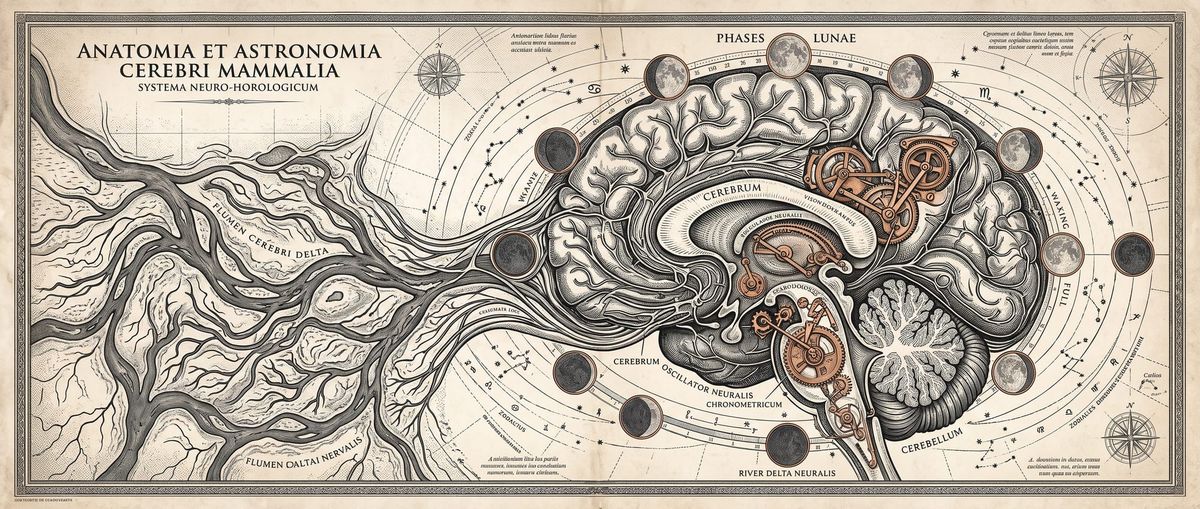
Most of us are accustomed to thinking of human cognition as an on-demand engine—our brains think when we are awake, conscious, and paying attention, and when we fall asleep or go under anesthesia, the computational lights simply go out. Learning, in this view, is then the active accumulation of data points during task performance, while rest is merely biological maintenance, clearing metabolic trash and resting the hardware.
But the biological brain is a non-stop, 24-hour predictive modeling engine. It runs sophisticated statistical inference across multiple temporal scales simultaneously; it rewires its deep representational geometry while completely unconscious; and, its most critical learning algorithms operate during the quiet intervals between events. This week, we explore three remarkable studies that show how the brain computes while we aren't looking.
Research Roundup
Reward Predicting Reward
Our brains are constantly trying to predict rewards. What could that possibly have to do with AI agents?
A recent Nature paper tracked hippocampal neurons in mice over several weeks as they learned a demanding reward task. Early on, neurons fired for the reward itself. With experience, that activity migrated backward in time to the cues that preceded the reward. The same cells, followed across weeks, shifted from "this is the payoff" to "this is what comes before the payoff." A simple temporal-difference model reproduces the whole thing.
I mention this because of all time enthusiastic entrepreneurs and product designers who seek to “gamify” learning. But value only propagates backward if there's an interval for it to propagate across. Gamified learning collapses reward onto the moment of the correct response. There's no temporal gap for anything to move into, so long-horizon prediction never gets built.
AI-supplied answers may be worse. The feeling of knowing arrives with the answer, so the reward attaches to the information and to the act of asking, not to the struggle that comes with exploring and friction-full learning.
The student we actually want is the one for whom confusion itself feels promising. The error in gamification and AI tutoring isn't that they use reward; it's that they make the horizon too short for the growth to happen.
Cyborgs Only Sleep on the Inside
Ever since I learned as a kid that dolphins can sleep one half of their brains while remaining awake in the other half, I’ve thought, “I want that superpower!” But human brains just don’t work that way. The cognitive benefits of sleep—synaptic downscaling, metabolic clearance, and memory consolidation—require global, organism-wide loss of consciousness.
But is sleep truly an all-or-nothing brain state or can its computational mechanisms be decoupled from total shutdown?
In a breakthrough study in Nature, neuroscientists tested whether the core electrophysiological hallmark of slow-wave sleep—synchronized neuronal activity alternating between brief bursts ("on" periods) and silence ("off" periods)—could achieve sleep's benefits while animals remained awake. Using optogenetics, they locally induced rhythmic on/off slow-wave cycles in fully awake, active mice.
Superpower achieved…ish. Bilateral induction of these on/off states in the cortex of sleep-deprived mice completely prevented cognitive deficits, successfully consolidating motor memories that would have otherwise been erased by sleep deprivation.
Sleep is not an immutable global state; it is at least partially modular and local. Of course, the part of your brain that is asleep might not be terribly effective at its job, but then again, I’ve had plenty of days at work where none of my brain was very effective at its job.
The Unsleeping Brain
Does learning require paying attention or even being aware?
A new Nature paper recorded individual neurons in the hippocampus of patients under general anaesthesia—no awareness, no memory of the session afterward. The researchers played them sequences of tones with an occasional oddball mixed in, then played them natural speech.
The unconscious hippocampus “noticed” the oddballs. More striking, it got better at noticing them over the 10 minutes of the experiment. Not only was it learning, but when the speech came on, the same neurons tracked not low-level beeps and boobs but high-level meaning and grammar. The unconscious hippocampus began predicting what the next word would be about before it arrived.
Consciousness is a story we tell ourselves, but it is probably not the source of the story's elements. Pattern detection, prediction, even a surprising amount of language processing run underneath awareness and keep running when awareness is switched off. What we experience as "figuring something out" may be the narration layer catching up to work that was already done.
If the unconscious brain is this busy, the question for anyone who designs learning, work, or products isn't how to capture attention. It's what we're feeding the machinery that runs without it.
Takeaway: Decoupling Compute from Consciousness
If you step back and connect these neurobiological mechanisms, a radical picture of human cognition comes into focus: Consciousness is not the engine of computation; it is merely the narrow bottleneck through which the engine occasionally selects its inputs and organizes the results.
For centuries, educational philosophy, workplace ergonomics, and cognitive theory have been built around the "conscious workbench" model: real learning happens when a student sits focused on a worksheet or when a professional stares intensely at a terminal. When we stop staring, we assume the work stops. But these studies prove that our neural computation—temporal difference value propagation, semantic feature extraction, and synaptic downscaling—can happen offline, non-consciously, and across distributed intervals.
Consider the educational and technological implications:
- The Trap of Instant Gratification: The hippocampal predictive coding paper proves why modern gamified education and instant AI-generated answers often fail to build deep mastery. Value only migrates backward across neural circuits if there is an unresolved temporal and cognitive interval between the problem and the resolution. When an AI tool provides an immediate answer, it compresses the reward horizon to zero. The brain never does the backward propagation work; no predictive map is built.
- Synthetic Cognitive Rest: The discovery that localized slow-wave "micro-cycles" fulfill sleep consolidation in the awake cortex means we can rethink cognitive pacing. The future of human-computer interfaces isn't just about feeding higher bandwidth into the brain; it’s about timing the micro-pauses—delivering targeted, transient neuromodulatory cues that allow specific cortical patches to engage in local synaptic resets while we transition between tasks.
- Subconscious Incubation: Your brain is continuously parsing semantic grammars and updating latent trajectories while you sleep, walk, or zone out. We need to stop designing our work lives around uninterrupted 8-hour blocks of hyper-focused screen time. True cognitive leverage comes from seeding an ill-posed problem into the architecture, introducing the necessary friction, and then getting out of the way so the background machinery can solve it.
Media Mentions
?
SciFi, Fantasy, & Me
To dive into speculative explorations of layered cognition, automated minds, and dream engineering, try the previously mentioned Gnomon by Nick Harkaway: A labyrinthine, near-future mystery exploring panoptic surveillance, nested identities, and memory consolidation inside a distributed cognitive network.
Now that I’ve read it I understand both the critical accolades and the mediocre Amazon review: it is a literary expedition.
Stage & Screen
- September 16, DC: AI and education–beyond dreams and dread.
- September 19, Phoenix: I'm giving the keynote for the Association of Science & Technology Centers annual conference.
- September 19, SF: Innovation Day with INSEAD!
- September 21, Stanford: We're still working on the details, but hopefully I'll be talking about my research on machine learning and neurodiversity for Stanford's Neurodiversity Project.
- September 24, UC Berkeley: It's my annual Berkeley Change-makers Lecture!
- September 29, Cincinnati: It's on, baby!
- September 30, Irvine: Hybrid Intelligence for innovation!
- October 6, SF: I'm return to Techonomy.
- October 6, SF: Giving a talk at the Draper Richards Kaplan Foundation
- October 7, Park City: It's Robot-Proof in the Rockies with setups.
- October 15-16, NYC: I'll be celebrating with Forbes' other "50 Over 50" honorees...
- Hey, I'll be in NYC already that week, book a keynote or briefing!!
- October 19-23, Warsaw: So much good stuff is in the works for my first visit to Poland: students, entrepreneurs, policy makers and more.
- I'm in Poland for the week: book me for an incredible talk and support our amazing work.
- October 26, Bonn: It's on in Bonn!
- Uncertainly dominates:
- October 28, Fayetteville, NC: This is a big maybe, but I've never spoken in North Carolina before.
- or October 28-29, San Diego: ...or maybe I'll be at UCSD for a book talk.
- or October 29, Amsterdam: We'll walk through the canals of the mind.
- November 19, NYC: Secrets in the dark!
- Already next year: Helsinki, Orlando, Purdue, Curicao, Toronto, Monmouth, UMass, & NYC