The Brain's Two Engines
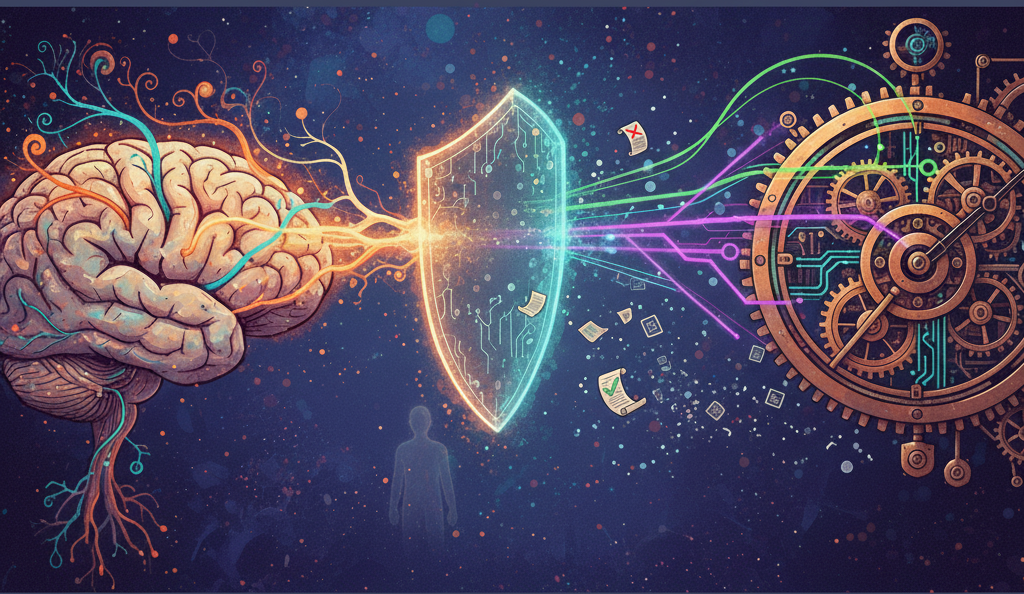
We like to think of our brain as a single, powerful algorithm producing "intelligence". But new research reveals it's more like a hybrid car, constantly switching between two very different engines: a fast, smart, gas-guzzling "planner" and a slow, efficient, habit-driven "autopilot." Understanding this dynamic switching is the key to understanding both human intelligence and the critical flaws in the AI we're building today.
Brains don't use a single algorithm. Why would we think AI will even match our scifi dreams without the messiness of natural intelligence?
Research Roundup
There is no One Ring for Cognition
Hey, AI Utopians, there is no single algorithm—DNN, LLM/transformers, RL—that scales to godhood. Human cognition is so much more interesting than a one-trick robot.
A new reanalysis of seven major datasets found that even human learning isn't a single process. It is a dynamical mixture of 2 very different engines::
- An Agentic Pilot: a “fast working-memory-based process” that flexibly adapts in real-time
- A Zombie Autopilot: a slow “habit-like associative process” that is rigid and automated
And “neither of which can be interpreted as a standard RL-like algorithm on its own”.
The singular intelligence we see in humans is a statistical ghost—the emergent result of these two systems, and many more, interacting with each other.
AI builders are trying to perfect the Autopilot—a massive, model-free associative engine. But an Autopilot on steroids still has no Pilot. LLMs are intelligent, yes, but the next step in machine intelligence isn't more parameters. It’s getting messy and building the Pilot.
Model Builders
So if our brain has an “Agentic Pilot” and a “Zombie Autopilot”, when does the brain switch engines? “Cognitive load” tells the story.
When the demands of the world fit inside our working memory capacity (different for each person), we rely on the flexible, computationally demanding "model-based strategy" of the agentic pilot.
But when the world overwhelms our mental capacity, we default to the less flexible but computationally cheap "model-free" autopilot.
When the world is routine and predictable, the model-free autopilot is fine. But when the world gets messy and ill-posed, such as during learning, only “model-based strategy and intelligence positively predict… learning performance”.
Learning, creativity, problem-solving—the very endeavors that demand our agentic pilot are the most likely to overwhelm and elicit the zombie…and we often don’t realize we've made the change. We hit a wall of complexity, the Zombie takes over, and we keep right on walking—thinking we’re still 'thinking' when we’re actually just reacting.
Robo-Recruiter II
Are LLMs “agentic pilots” or “zombie autopilots”? Let’s look at an everyday, ill-posed task that turns most professionals into shallow zombies: reading resumes.
A massive study on AI hiring reveals that LLMs have a massive self-preference bias, favoring resumes generated by AI over human-written ones by up to 88%—even when candidate quality is identical.
This “zombie” hiring means that “candidates using the same LLM as the evaluator are 23% to 60% more likely to be shortlisted than equally qualified applicants submitting human-written resumes”, with the worst effects in “sales and accounting”.
The AI isn't using a deep, "model-based" understanding of candidate quality. It's using a simple, "model-free" associative rule: pattern match for surface structure over deep causes. It's an AI running on autopilot, demonstrating a cognitive bias that mirrors our own when we're tired or overwhelmed.
Overwhelmed humans (part-time zombies) are using AI (full-time zombies) to screen candidates. The result isn't a better workforce; it’s a hall of mirrors where humans who write like humans are filtered out by machines that only “love” themselves.
We can aspire to be better than our inner zombies. We should probably start expecting the same from our tools.
Media Mentions
It's my book – my book is the mention! Buy Robot-Proof: When Machines Have All The Answers, Build Better People today. Better still, buy a signed copy along with my weekly newsletter right by going to https://socos.org/robot-proof can clicking "Subscribe!"
SciFi, Fantasy, & Me
I hated Beau in Critical Role’s “Mighty Nein” (campaign 2), though I admire Marisha Ray’s commitment to playing out her character concept. In the new “Mighty Nein” series on Amazon, she’s more enjoyable (and stinky).
This series might be called "inspired by not real events” rather than just animating the campaign, and I think it’s better for it. If you are missing some messy, funny, bloody storytelling, give it a try!
Bonus: only fools pass up a Mark Strong baddie!
Stage & Screen
- January 20, Davos: After all these years, they are finally allowing me to speak in Davos at the World Economic Forum.
- February 2, NYC: My latest research on neurotechnologies for cognitive health and more.
- February 10, Nashville: Shockingly, I haven't visited Nashville since I was a little kid. On this trip I'll be looking at why Tennessee and North Carolina appear to have more entrepreneurship than all over their neighboring states combined.
- March 8, LA: I'll be at UCLA talking about AI and teen mental health at the Semel Institute for Neuroscience and Human Behavior.
- March 14, Online: The book launch! Robot-Proof: When Machines Have All The Answers, Build Better People is will finally be inflicted on the world.
- Boston, NYC, DC, & Everywhere Along the Acela line: We're putting together a book tour for you! Stay tuned...
- Late March/Early April, UK & EU: Book Tour!
- March 30, Amsterdam: What else: AI and human I--together is better!
- plus London, Zurich, Basel, Copenhagen, and many other cities in development.
- April, Napa: The Neuroscience of Storytelling
- June, Stockholm: The Smartest Thing on the Planet: Hybrid Collective Intelligence
- October, Toronto: The Future of Work...in the Future