The Tangible Economics of an AI Boom
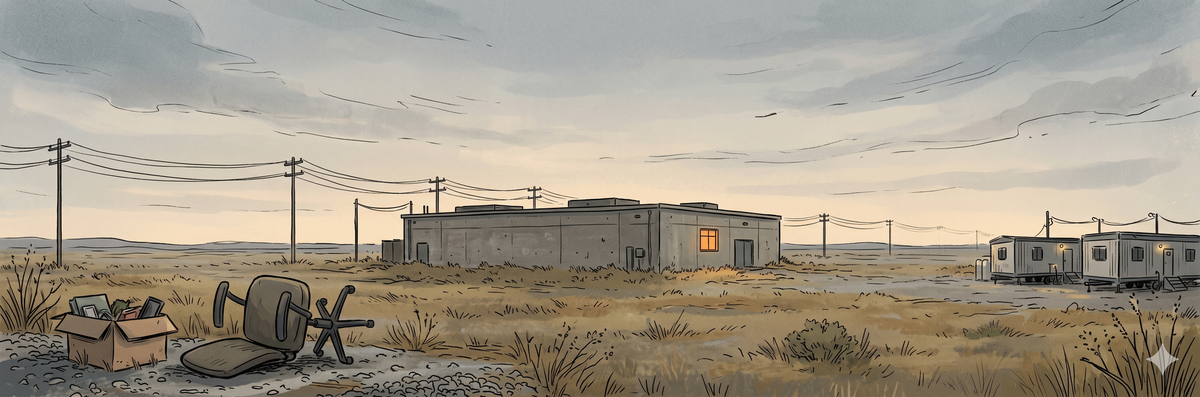
Three new papers, three different angles on the economics of the AI Boom. AI is creating real value, real productivity gains, real new firms. It's also pulling out the bottom rungs of the career ladder and pushing costs onto people who never signed up for the trade. The distributional story is where the action is: who's capturing the upside, who's absorbing the cost, and is anyone is paying attention to the difference?
Research Roundup
3 Cents on the Dollar
If AI is saving you money on human labor, who’s the canary in the coal mine? The same labor you already used to replace full employees: contract workers. So, let’s peek in on the gig economy…
A new working paper tracked corporate expense data from Q3 2021 through Q3 2025 focusing on 2 line items:
1. freelance “marketplaces (such as Upwork and Fiverr)”, and
2. “AI model providers”.
Using ChatGPT's launch as a natural experiment (difference-in-differences model), the results show that (2) is eating (1): firms with the heaviest pre-ChatGPT freelance spending adopted AI earliest and most aggressively, while “reducing spending on contracted labor”.
Among the most exposed firms, every $1 drop in freelance spending corresponded to roughly $0.03 of new AI spending. Whatever the freelancer used to do for a dollar, the firm now thinks it can get for 3 pennies of API credit.
I wrote about this nearly 10 years ago and in some of the earliest drafts of 𝑹𝒐𝒃𝒐𝒕-𝑷𝒓𝒐𝒐𝒇. The routine labor is being automated right now—not in 2030. it's already in the expense reports.
StartupVille 3.1
I’ve written about how agentic AI is affecting education and employment, but what about one of the biggest drivers of economic growth in the world: entrepreneurship. A new paper analyzed data on the U.S. startup ecosystem before and after ChatGPT.
Venture Firms: VCs responded to agentic by writing more, smaller checks, which has driven an increase in new firm formation.
Startups: those with higher exposure increased productivity, scaled faster, and moved through funding rounds quicker. They also cut headcount within 2 quarters, leading to…
Employees: cuts landed almost entirely on junior employees and those in (routine) implementation roles. These displaced employees took longer to find new jobs, and the jobs they eventually took paid less and were often in new fields. Aggregate employment is unchanged, but shifted toward senior roles.
AI isn't shrinking the startup labor market, but it is definitely restructuring it. The bottom of the ladder is getting thinner; the top is getting busier. And the path from junior to senior that used to run through a few years of execution is now budgeted to agents.
Founders are figuring out they can run leaner with senior talent and AI tooling. The question for everyone else is how you reach the senior tier when the rungs you used to climb are “inefficient”.
Boomtown
Industry wants the AI boom, but few communities want what physically powers it: intrusive, costly data centers. A new paper maps every U.S. data center to its county and measures what happens after one shows up. The results are mixed in a way that should reshape how local governments think about these deals.
On the upside, opening a new data center leads to increases in
- data-processing jobs,
- construction jobs,
- new establishments,
- higher tax returns,
- higher adjusted gross income, and
- higher wages.
This looks like real economic activity, not just press releases.
On the downside, home prices and energy costs go up for everyone on that grid, not just the hyperscaler signing the lease. And the higher wages doesn’t translate into more jobs for everyone.
Whether that trade is worth it depends entirely on who's signing the deal and who's paying the bills. Right now, in most counties, those aren't the same people. But if I were voting between a data center, 99-year no-tax bigbox store lease, or a publicly funded stadium for a private sport franchise…sell me compute.
Media Mentions
There are two big new articles about about Robot-Proof and me:
- Dan Cost wrote published a long conversation with me in Worth magazine.
- Nick Lichtenberg then took a dive into my work in Fortune.
Between "Fortune" and "Worth" you can surely find some value in my media this week :)
SciFi, Fantasy, & Me
I was not a fan of The Big Bang Theory (or Frazier) because I was never that into broad characterizing of smart people as buffoons. But then I saw the trailer for Stuart Fails to Save the Universe and I must know more.
Stage & Screen
- May 21, Online: "How AI is Changing Finance"
- May 29, Online: AI & the Future of Creativity
- June 11, Luxembourg: How Europe (and even some of it smallest states) compete and grow in a trade environment dominated by zero-sum leaders
- June 18, Stockholm: The Smartest Thing on the Planet: Hybrid Intelligence
- June 25, Online: "The Tax On Being Different" can't be wished away
- July 7, MIT: I'm giving the keynote for the MIT App Inventor Global Education Summit taking place this year at MIT CSAIL.
- July 8, NYC: It a book talk for Robot-Proof at the Harvard Club...how swanky!
- Maybe July 24...Maybe San Diego: Maybe....
- September 19, Phoenix: I'm giving the keynote for the Association of Science & Technology Centers annual conference.
- September 21, Stanford: We're still working on the details, but hopefully I'll be talking about my research on machine learning and neurodiversity for Stanford's Neurodiversity Project.
- September 24, NYC: Culture Shifting Deal Making Summit
- September 29, Cincinnati: Still baking...
- September 30, Irvine: Hybrid Intelligence for innovation!
- October 6, SF: UCSD Alumni Association
- October 6, SF: Giving a talk at the Draper Richards Kaplan Foundation
- October 21-23, Warsaw: So much good stuff is in the works for my first visit to Poland (and maybe time in Germany as well!)
- October, Toronto: The Future of Work...in the Future
- November 19, NYC: Secrets in the dark!