The Thermodynamics of the Hive: How Flocks, Herds, and Bureaucracies Compute Without Managers
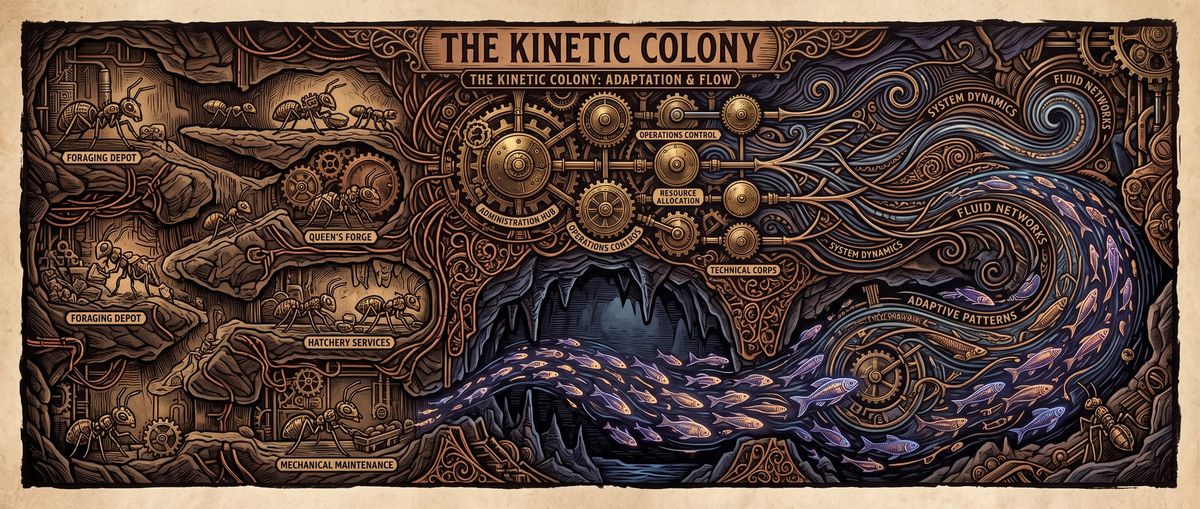
Most people think coordination requires an architect. Whether managing a distributed engineering sprint, migrating a bird flock, or keeping a mammalian huddle warm in a blizzard, our default intuition is to search for the command node—the conductor waving the baton or the centralized database holding the global lock. But natural and formal systems have spent millions of years solving the same physics problem: centralized coordination is a massive computational bottleneck, energetically expensive, and terrifyingly fragile.
True systemic resilience is almost never top-down; it is an emergent thermodynamic property of local threshold variation, compensatory behavioral feedback, and mathematical monotonicity. This week, we examine three papers that deconstruct how decentralized groups compute, allocate labor, and stabilize under stress without ever needing an executive meeting.
Research Roundup
The Daring Few, The Patient Many…The Credit-Stealing Pricks
How does a group of self-interested, leaderless individuals balance the brutal trade-off between exploration (high-risk scouting) and exploitation (reaping known resources) without centralized control? We could build a model…but fortunately a daring few researchers already did.
This model of collective foraging consists of individuals sharing environmental information and resources but independently choosing whether to bear the costs of scouting or to idly lounge in safely. The model demonstrates that, without any central leadership, decentralized groups achieve near-optimal efficiency simply through behavioral diversity. A tiny, daring minority continuously incurs the costs of exploration during lean times; their discoveries instantly create conditions that allow the idle majority to synchronize and exploit bountiful patches.
All of that information sharing has benefits that grow with scale. The optimal number of scouts only grows logarithmically with group size: in other words, a massive colony needs proportionally fewer scouts than a small troop.
Furthermore, the model reveals a curious asymmetry: these decentralized groups detect deteriorating conditions almost instantly (as foragers abandon dry patches), but are significantly slower to recognize environmental improvements because maintaining the exploratory vanguard during environmental downturns is biologically expensive.
High-performing decentralized collectives don’t need every member to be an adaptable polymath. They require stable individual differences in risk tolerance, where a small, static fraction of restless scouts subsidizes the operational efficiency of the collective whole.
Of course, the majority have to be willing to accept those very different individuals, and those very different individuals have to love bearing all of the risk for the good of the rest. If only math was people.
Cuddling for Science
When stress hits a social group, survival depends on rapid behavioral change, such as huddling together to conserve heat in a cold snap. But how does an individual mammalian brain decide to join or leave the huddle, and what happens when key players stop cuddling?
Freely behaving mice subjected to cold challenges engaging “collective huddling” [1]. This is governed by two distinct behavioral strategies: active entries/exits (self-initiated actions) and passive transitions (prompted by the movement or displacement of partners). Within a crucial region of the cortex, dorsomedial Prefrontal Cortex (dmPFC), these two strategies are mediated by distinct, non-overlapping neuronal ensembles.
When the "active decision" neuronal ensembles were selectively silenced, those mice stopped initiating huddle formations. This failure to cuddle for the collective good [2] doesn’t doom the team, however; cage mates spontaneously compensate by increasing in their own active entries, preserving the group’s total aggregate huddle time. [3]
Cute story short: social resilience is a distributed homeostatic circuit. Our cortex encodes distinct neural representations for initiating versus accommodating collective behavior, creating a dynamic reserve where unaffected individuals passively or actively buffer against the functional deficits of their peers. [4]
[1] Cuddling…right? Collective huddling is cuddling. It must be.
[2] Thanks, evil scientists!
[3] This whole experiment could only be cuter if they used blue penguins. Look ‘em up.
[4] But probably don’t cuddle with random coworkers just because the office is a little chilly.
Blaine the Mono says, “Automate.”
Organizations spend billions of dollars and untold human hours on synchronization meetings, status checks, and multi-agent consensus protocols. But how much of this coordination is required to guarantee a correct outcome? If you trust math, it is all about monotonicity.
In distributed computing, coordination is strictly necessary only when a task specification is nonmonotonic, meaning that the arrival of new information can invalidate previously reached conclusions (requiring rollbacks, interrupts, and global consistency locks) [1]. If a task is monotonic, intermediate information only adds to the state without ever contradicting prior steps, meaning agents can execute independently and asynchronously in any order.
A new paper evaluated 65 enterprise workflows and 13,417 tasks (from ONET) in terms of monotonicity to argue that: 74% of standard business workflows and 42% of all ONET occupational tasks are strictly monotonic. This implies that between 24% and 57% of existing organizational coordination spending is completely unnecessary for task correctness.
In other words, more than a third of the meetings currently on your calendar could be replaced by an asynchronous append-only ledger, and the universe would not know the difference.
Faced with hated uncertainty, management reflexively designs human organizations and multi-agent AI pipelines around tight, synchronous coordination policies. If you trust the math, most real-world tasks are commutative and monotonic; stripping out the coordination layer doesn't introduce chaos—it removes artificial drag. [2]
[1] More generally, a monotonic function is constant or moves in one direction (e.g. always increasing), but the analogy holds.
[2] Yes, someone has taken the daring stand of blaming middle management.
Media Mentions

I hope to see you there!
Register for the INSEAD AI Forum Americas.
SciFi, Fantasy, & Me
This week I shared papers on the frequent optimality of decentralized collective behavior. For the exact opposite, try A Trade of Blood by Robert Jackson Bennett, Book 3 of the “Ana and Din Mysteries”. In this outing, our alchemically altered sleuths are solving a who-done-it of ecological proportions.
Stage & Screen
- September 8, Online: How might AI change the world of supermarkets?
- September 8, Palo Alto: A Brown Bag lunch chat on anything and everything with the Hewlett Foundation
- September 10, San Francisco: Come spend the day with me at super{set} https://rewirecon.com/
- September 16, DC: AI and education–beyond dreams and dread.
- September 19, Phoenix: I'm giving the keynote for the Association of Science & Technology Centers annual conference.
- September 19, SF: Innovation Day with INSEAD!
- September 21, Stanford: We're still working on the details, but hopefully I'll be talking about my research on machine learning and neurodiversity for Stanford's Neurodiversity Project.
- September 24, UC Berkeley: It's my annual Berkeley Change-makers Lecture!
- September 29, Cincinnati: Still baking...
- September 30, Irvine: Hybrid Intelligence for innovation!
- October 6, SF: I'm return to Techonomy.
- October 6, SF: Giving a talk at the Draper Richards Kaplan Foundation
- October 7, Park City: It's Robot-Proof in the Rockies with setups.
- October 8, Chicago: It's "The Next Era in Automotive Retail" with the FT. Join in person or online.
- October 15-16, NYC: I'll be celebrating with Forbes' other "50 Over 50" honorees...
- Hey, I'll be in NYC already that week, book a keynote or briefing!!
- October 19-23, Warsaw: So much good stuff is in the works for my first visit to Poland: students, entrepreneurs, policy makers and more.
- I'm in Poland for the week: book me for an incredible talk and support our amazing work.
- October 26, Bonn: It's on in Bonn!
- October 28, Fayetteville, NC: This is a big maybe, but I've never spoken in North Carolina before.
- October 28-29, San Diego: ...or maybe I'll be at UCSD for a book talk.
- November 19, NYC: Secrets in the dark!
- Already next year: Helsinki, Orlando, Purdue, Curicao, Toronto, Monmouth, UMass, & NYC