Why Singapore’s Plan to Gamify Reading Will Starve the Brain
Why Singapore’s Plan to Gamify Reading Will Starve the Brain
(Sorry for the unscheduled hiatus last week. Too many things—good, bad, and ugly—all need me more than you.)
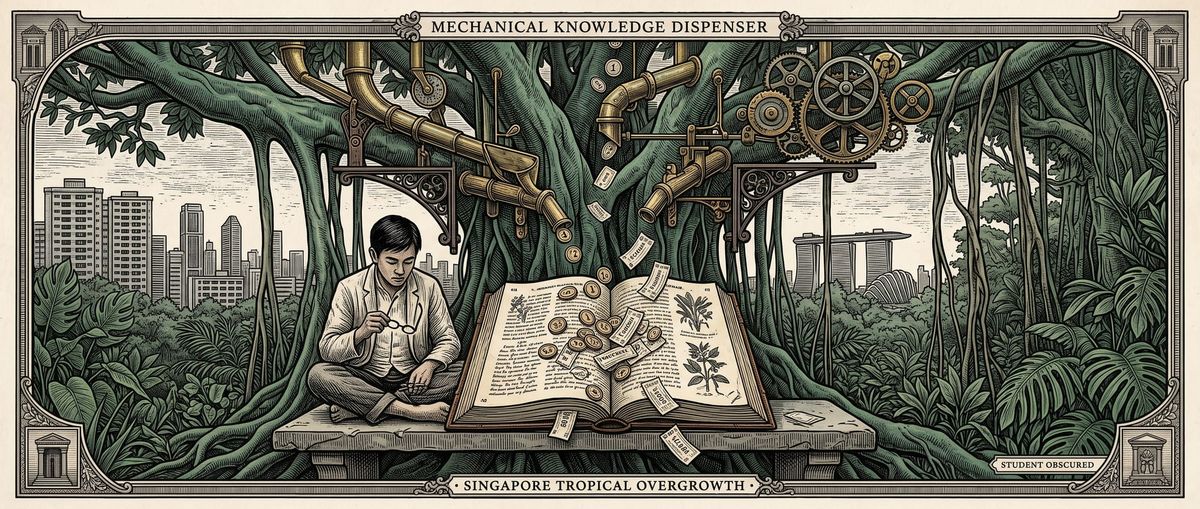
Singapore’s recent policy push to gamify reading—dangling redeemable points, app-based quest badges, and monetary lifestyle rewards to get citizens to open books—is a textbook study in technocratic good intentions colliding with biological reality. [1]
The underlying premise seems obvious to any policy committee: if reading is virtuous, and people aren’t reading enough, simply attach an external incentive gradient to the behavior to get the numbers moving in the right direction. But human literacy is not a logistics problem, and the brain is not a spreadsheet.
Reading for deep comprehension relies on an exquisitely delicate, high-latency neural architecture. When you pay a human being—whether in cash, transit vouchers, or digital experience points—to consume a book, you do not cultivate an endogenous love of literature. You train a reinforcement learning agent to find the shortest, shallowest path to the token, effectively short-circuiting the very neural machinery required to find deep reading rewarding in the first place.
In a previous newsletter I explored the foibles of gamified edtech; this week let’s dive into 3 more papers on why gamification is NOT the magic wand too many think it is.
[1] Singapore is a society so exceptionally efficient that one suspects if they could figure out a way to outsource dreaming to a public-private partnership with tax breaks for sleep quality, they’d have a pilot program running by Tuesday morning. But my last newsletter notwithstanding, brains just need to sleep.
Research Roundup
When the Brain Locks Onto the Scoreboard
What actually happens inside the mammalian nervous system when an intellectual task is wrapped in game mechanics? Fit experimental participants with high-density EEG and give them a learning task. The results are messy.
In the experiment, those participants performed a mental arithmetic learning task under 2 conditions:
1. competing head-to-head against an opponent or
2. working in a self-referential condition focused on beating their own past performance.
The experiment tracked 3 neural signatures during outcome feedback: “Reward Positivity” (RewP), the P300 (an attention marker), and “feedback-related negativity” (FRN).
The split was unmistakable. While the attentional signal of the P300 was elicited across both settings, RewP amplitude—a proxy electrophysiological signature of dopamine-driven reward processing in subcortical valuation circuits—scaled specifically and aggressively with external competitive feedback. In fact, an individual's RewP amplitude predicted their competitive orientation score in out-of-sample machine learning models.
When learning is framed through gamified mechanics, the brain's valuation circuitry rapidly reallocates metabolic resources away from semantic error-monitoring and task representation, re-anchoring instead onto the external status signal. The brain ceases to ask “How does this concept connect to what I already know?” and instead asks “Did I win the token?”
The High-Volume Trap of "Just Playing the Game"
If gamification drives learning—racking up high-frequency "plays" to organically build domain mastery—then Chess.com should tell a powerful tale of mastery. It’s does….but not for the gamified part.
A massive study of 44,213 chess players on Chess.com used time-stamped activity data spanning millions of hours. It tracked the relationship between skill development (as evidenced by rating gains) and 2 types of activity: playing actual rated games (the gamified, rating-chasing, highly addictive core loop) versus engaging in structured, deliberate practice activities (such as isolated tactic puzzles and endgame studies). [1]
Despite players dedicating over 90% of their total platform time to playing games, deliberate practice exhibited a 3.61× advantage in learning efficiency.
Grinding through gamified matches delivers constant stimulation, emotional stakes, and rapid feedback, but it forces the cognitive reorganization needed for skill progression. High-frequency gamified execution drives learners' reward system but without the rigorous, slow architectural reconstruction that actually yields expertise.
[1] If you sense that I’m about to say that you need to do boring fundamentals to learn…huzzah, you're paying attention.
The Myth of the Artificially Pumped Learner
Gamification engines are heavily reliant on manufactured success: leveling curves, low-friction "achievements", and early praise designed to artificially inflate a user's confidence and keep them hooked to the interface. But does artificially elevating confidence actually produce downstream learning benefits?
A tripartite study tested this across a preregistered replication, a computational simulation, and an experimental intervention. Initial comparisons replicated the widely reported correlation between overconfidence and subsequent task persistence, but it was an illusion.
The computational models and experimental intervention revealed that this effect was an artifact of participant-selection bias and regression-to-the-mean. When children’s overconfidence levels were experimentally manipulated, the supposed learning advantage completely evaporated.
Manufacturing an artificial sense of triumph does not improve cognitive uptake or make children more resilient learners. It merely uncouples their metacognitive self-assessment from reality, leaving them vulnerable the moment external praise is removed.
Media Mentions
One of the funnest things I've ever done was give the closing keynote for the 2019 Grace Hopper Conference to 30,000 amazing young women. And so it was my pleasure joining the Anita Borg Inst's "B The Way Forward" pod cast:
Don't let the title mislead you: I am a hardcore AI realist. It human choice that drives the future.
Go out and make a difference in the world!
SciFi, Fantasy, & Me
On the theme of technocratic behavioral conditioning and the loss of endogenous human drive, look no further than a classic: Stanislaw Lem’s Return from the Stars. In it, an astronaut returns to an Earth where all aggression, danger, and struggle have been medically and socially engineered out of human society through a process called "betrization".
The resulting utopia is completely peaceful, hyper-efficient, and horrifyingly hollow—a civilization that has successfully eliminated all psychological friction, only to discover it has permanently stripped itself of the capacity for wonder, daring, and meaning.
It truly is worth going back through the classics of SF to see that these ideas have been flying around for decades.
Stage & Screen
- September 29, Cincinnati: It's on, baby!
- September 30, Irvine: Hybrid Intelligence for innovation!
- October 6, SF: I'm return to Techonomy.
- October 6, SF: Giving a talk at the Draper Richards Kaplan Foundation
- October 7, Park City: It's Robot-Proof in the Rockies with setups.
- October 15-16, NYC: I'll be celebrating with Forbes' other "50 Over 50" honorees...
- Hey, I'll be in NYC already that week, book a keynote or briefing!!
- October 19-23, Warsaw: So much good stuff is in the works for my first visit to Poland: students, entrepreneurs, policy makers and more.
- I'm in Poland for the week: book me for an incredible talk and support our amazing work.
- October 26, Bonn: It's on in Bonn!
- Uncertainly dominates:
- October 28, Fayetteville, NC: This is a big maybe, but I've never spoken in North Carolina before.
- or October 28-29, San Diego: ...or maybe I'll be at UCSD for a book talk.
- or October 29, Amsterdam: We'll walk through the canals of the mind.
- November 19, NYC: Secrets in the dark!
- Already next year: Helsinki, Orlando, Purdue, Curicao, Toronto, Monmouth, UMass, & NYC