Why Your Brain Navigates Thoughts Like Landscapes
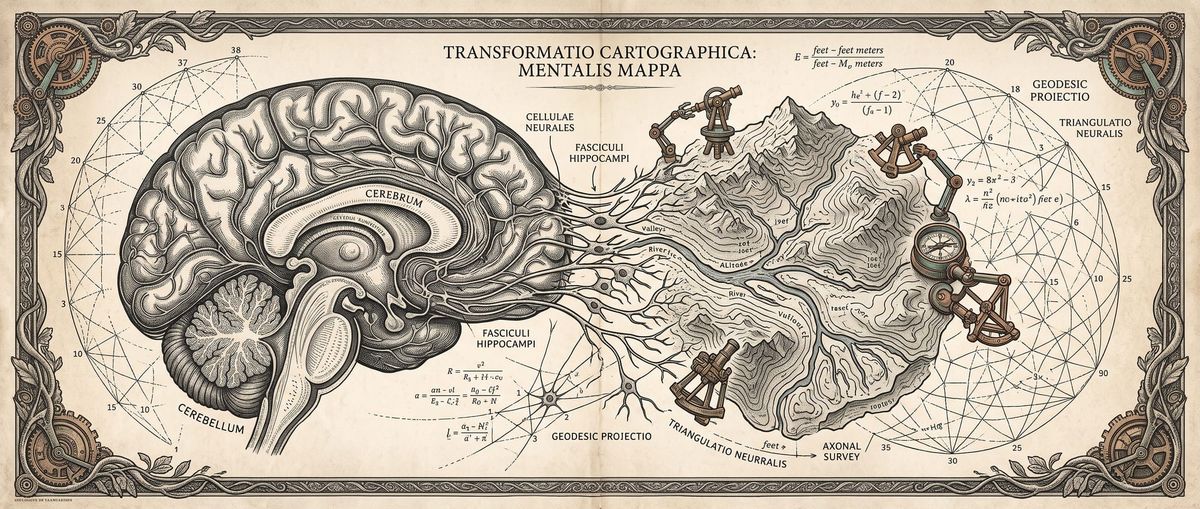
For decades, cognitive science fell into the trap of thinking about human memory as a dusty warehouse or a hard drive—a phantom archivist stashes files into folders, waiting for a retrieval query to fetch the raw data. It was an orderly, comforting, and thoroughly incorrect metaphor.
The brain is not an archivist; it is an active, predictive simulator running on 20 watts of wet biological circuitry. [1]
At the intersection of electrophysiology and computational neuroscience and psychology, I’ve always believed that the exact same neural machinery which evolved to prevent a mammal from getting eaten while navigating the underbrush is also what your neocortex uses to reason about tax brackets, play board games, and draft philosophical essays. We do not "think" in abstract logic; we traverse high-dimensional coordinate manifolds.
When you imagine the future, your brain isn't retrieving anything—it is physically navigating a simulated landscape.
[1] Barely enough power to keep a refrigerator bulb lit, yet capable of losing an afternoon pondering whether a raven is like a writing desk. I’m guessing Love Island require 1 watt—it’s the cognitive powersaver mode we didn’t need.
Research Roundup
Vectoring the Unseen Path
How does an animal plan a route to a destination it cannot currently see?
Rhythmic "theta sweeps"—sequential firing of hippocampal place cells within a single 8 Hz theta cycle—were often viewed as an automatic mechanism for local spatial sampling. Think of a sort of neural radar pinging left and right to map the immediate ground in front of the paws. But large-scale Neuropixels recordings in freely moving rats navigating an open arena toward remembered goals reveal a radically different and proactive mechanism.
When animals engage in goal-directed navigation, the hippocampal theta sequences abandon symmetric local sampling; instead, they stretch out into forward-directed trajectory vectors pointing straight toward distant, remembered goals. These predictive sweeps coordinate with prefrontal cortical activity.
These sweeps represent the physical footprint of mental simulation: the hippocampus is physically projecting the animal’s future trajectory across the map before the body commits a single muscle fiber. I wonder what conversational direction vectors look like in humans and if we can also see them in LLM embedding trajectories.
Scale Rewrites the Map
We run experiments in labs with highly controlled but often impoverished environments [1]. This means that some of what we think we are learning about ourselves is an illusion.
Take rats and Egyptian fruit bats [2]. Years of recordings place cells from 2 regions in the hippocampus—CA3 and CA1—would seem to suggest that they do nearly the same job. What a waste!
But a new experiment let those Egyptian fruit bats fly along custom-built, 200 meter flight tunnels rather than narrow little mazes. Suddenly, CA3 and CA1 don’t look so similar at all. In large “naturalistic” [3] environments, CA3 exhibited an ultrasparse code: individual neurons possessed almost exclusively single, pristine place fields, regardless of the flight tunnel’s length. CA1, by contrast, implemented an intensely dense multi-field code, with individual cells firing across multiple distinct patches of space.
Furthermore, CA1 neurons carried trajectory-history modulation—retrospective memory coding—that persisted for over 100 meters.
Computational modeling showed that this sparse-to-dense transformation provides an optimal compression engine: CA3 functions as an invariant, low-interference spatial index, allowing CA1 to rapidly assemble rich, context-dependent trajectories over vast operational distances.
[1] Or online…with similarly impoverished, high-controlled environment.
[2] Please!
[3] Hurray! Naturalistic science! This is what I like doing, and we need more of it. Not only it, but more.
In Sight / In Mind
Imagine the fearsome owlbear with its shaggy fur, cruel claws, and gnashing beak. [1] If you have imagined it, congratulations: you have seen it. The same neural infrastructure we use to see, down to the individual cell, we use to imagine.
Activity from 714 single neurons in the ventral temporal cortex (VTC) of 16 human patients undergoing intracranial monitoring for intractable epilepsy was recorded while they viewed images and subsequently imagined them. [2]
From that data experimenters were able to derive visual features of objects as vectors in specific geometric axes in a low-dimensional manifold of neuron activity. Crucially, when patients closed their eyes and simply imagined the objects, roughly 40% of these axis-tuned neurons reactivated. Their firing rates during pure imagination were strictly proportional to the projection value of the imagined object along that neuron’s preferred viewing axis.
All of that is to say that internal imagination is not a distinct or symbolic cognitive loop. To imagine a face or an apple is to drive your sensory cortex along the exact same high-dimensional geometric coordinates used to parse the physical world. You are inferring turtles, all the way down.
[1] You are free to stop imagining it now. It is a silly thing that only a Dungeons & Dragons fan could love (to hate).
[2] I’ve written before about the huge, positive impact these epilepsy patients have had on neuroscience. Years of donating recordings of their brain activity to science has been a boon for us all.
Takeaway
The human mind is high precision intelligence built out of wonky old bio-code from millions of years past. The navigational algorithms our evolutionary ancestors developed to crawl out of the sea, forage across savannahs, and fly through dark caves were never discarded; they were simply repurposed and expanded, again and again.
Consider what this means for understanding of higher human cognition. When you sit at a desk pondering a chess position, architecting a software database, or agonizing over a career choice, you are not manipulating abstract, disembodied symbols. Your CA3 and CA1 networks are laying down sparse indices and dense context trajectories; your prefrontal cortex is coordinating with hippocampal theta sweeps to fire trial trajectories toward potential destinations; and your ventral temporal cortex is driving neural ensembles along sensory axes to literally look at things that do not exist in the physical room.
Media Mentions
Remarkable People; Guy Kawasaki and I talked about what makes humans remarkable in the age of AI, and why the best use of AI is to make us better at exploring the unknown, not to think for us. It was a genuinely fun conversation.
Listen here: https://guykawasaki.com/what-makes-humans-remarkable-in-the-age-of-ai-with-vivienne-ming/
SciFi, Fantasy, & Me
Greg Egan’s Permutation City remains a high-water mark for hard science fiction that takes computational metaphysics seriously. Set in a near future where the wealthy scan their consciousness into digital "Copies"—purchasing server runtime to evade biological death—the novel quickly abandons standard cyberpunk tropes to confront something far more terrifying: "Dust Theory".
Scatter the computational steps of thought across random atoms throughout the cosmos over billions of years, and the pattern will still knit itself together from the inside out, generating its own unbroken, self-consistent subjective reality.
Permutation City offers few easy, comforting humanism. It tracks what actually happens when human minds begin altering their own source code, sliding their own subjective time scales, and engineering self-contained synthetic ecologies out of cellular automata.
Stage & Screen
- September 16, DC: AI and education–beyond dreams and dread.
- September 19, Phoenix: I'm giving the keynote for the Association of Science & Technology Centers annual conference.
- September 19, SF: Innovation Day with INSEAD!
- September 21, Stanford: We're still working on the details, but hopefully I'll be talking about my research on machine learning and neurodiversity for Stanford's Neurodiversity Project.
- September 24, UC Berkeley: It's my annual Berkeley Change-makers Lecture!
- September 29, Cincinnati: It's on, baby!
- September 30, Irvine: Hybrid Intelligence for innovation!
- October 6, SF: I'm return to Techonomy.
- October 6, SF: Giving a talk at the Draper Richards Kaplan Foundation
- October 7, Park City: It's Robot-Proof in the Rockies with setups.
- October 15-16, NYC: I'll be celebrating with Forbes' other "50 Over 50" honorees...
- Hey, I'll be in NYC already that week, book a keynote or briefing!!
- October 19-23, Warsaw: So much good stuff is in the works for my first visit to Poland: students, entrepreneurs, policy makers and more.
- I'm in Poland for the week: book me for an incredible talk and support our amazing work.
- October 26, Bonn: It's on in Bonn!
- Uncertainly dominates:
- October 28, Fayetteville, NC: This is a big maybe, but I've never spoken in North Carolina before.
- or October 28-29, San Diego: ...or maybe I'll be at UCSD for a book talk.
- or October 29, Amsterdam: We'll walk through the canals of the mind.
- November 19, NYC: Secrets in the dark!
- Already next year: Helsinki, Orlando, Purdue, Curicao, Toronto, Monmouth, UMass, & NYC