Willpower

Resilience, GRIT, Willpower–we have so many ideas about our emotional intelligence plays out int he real world. This week we'll take a tour through some recent research on some core question that expand and alter the very concept of "willpower".
Research Roundup
The Belief Behind the Belief
Believing that willpower is a limited resource, depleted by effort, predicts how well you hold up under sustained demand. It turns out these “lay” beliefs about willpower even shape whether people will put in effort in the first place.
While “willpower is finite” believers consistently chose easy math problems throughout a session, the “willpower isn’t limited” crowd chose harder problems and chose increasingly difficult problems as they went.
This wasn’t just correlation—when the experimenters induced limited vs unlimited mindsets, peoples choices of effort level track their treatment. They induced effort avoidance in the willful and hard work in the “lazy”.
The harder question is what a "belief" even is here. It's captured by a few agree/disagree items and treated as a stable trait, yet the same literature shows these scores shift after a paragraph of framing, vary cross-culturally with ambient attitudes toward effort, and plausibly track sleep, mood, and time of day. That looks less like a deeply held theory and more like an accessible self-narrative about effort.
The standard framing is belief shapes how you read fatigue, which shapes behavior, but your current state—rested, fed…frustration with your last math problem—could be driving both body and belief. Or more likely it’s a big messy tug of war between all of these factors. Telling "I now believe effort is energizing" apart from "I'm in a state where effort feels manageable" is genuinely hard with self-report.
A construct can look like a trait at the population level while behaving like a state at the individual one. Treating “belief” as a stable lever probably overstates how much sits in the belief itself versus in the conditions that make a given belief feel true. Intervening on the belief is palliative. Intervening on the conditions is structural.
Two Routes to "Aha"…or One
Does neurodiversity bring a creativity advantage?
Nearly 300 participants went through a 3-step experiment to answer this question. First, they self-reported ADHD symptoms. Then they had to complete a remote association task, where one word links 3 others together (e.g. ‘pine’, ‘crab’, ‘sauce’ → ‘apple’). Finally solvers reported whether their answer arrived through deliberate search or as sudden insight, the classic "Aha."
People with the highest self-reported ADHD severity more often claimed “insight”, while people with the lowest said “analysis”. Interestingly, both extremes outperformed the middle—a classic U-shaped curve.
The authors read this as support for a two-route model of creative problem-solving: weak executive function (ADHD) favors a fast, associative, Type-1 pathway; strong executive function favors a slow, deliberate, Type-2 one. Moderate executive function is good at neither—middling cognitive control may be the worst of both worlds, neither loose enough to surface remote associations nor focused enough to grind through a search.
My deep reservations about self-report aside, people high in ADHD symptoms aren't necessarily relying on a different system than those low in symptoms; their neural architecture may reveal complex interactions in differing ways: high-ADHD defined by broader associative search, weaker top-down pruning, and lower threshold for letting a candidate solution break into awareness. The U-shape then reflects a differing balance of complex interactions.
Lies We Tell Ourselves
Is lying the rule or the exception? To answer this, let’s review a database of lies [1].
It contains 632 people, 91 days, 116,366 self-reported lies, and tells an expected story. Most people lie rarely, a small minority lie a lot [2], and roughly three-quarters of participants are stable low-frequency liars.
Lying makes up about 7% of total communication; of those, nearly 90% are little white ones. Stable individual differences account for about 58% of the variance; day-to-day fluctuation accounts for the other 42%.
"A few prolific liars" is the part that will get all the press, and the data support it. But the 42% is where the more interesting question lives. Nearly half the variance in lying isn't about who you are; it's about what kind of day you're having and how much you’ve prepared for it. Good lie days and bad lie days are real, and they're nearly as predictive as personality.
Honesty and courage are often discussed as if it were a fixed property of a person, like height. They’re more like blood pressure: there's a personal baseline, but the moment-to-moment reading depends on what's happening around and inside you as well as how much you’ve exercised.
If you want less lying in an organization, a relationship, or a classroom, the trait framing tells you to screen for honest people. The variance decomposition tells you that context—psychological safety, time pressure, what gets punished, what gets rewarded, whether the truth is survivable–and preparation are under our control.
[1] No, not press releases from the White House.
[2] Yes, press releases from the White House.
Media Mentions
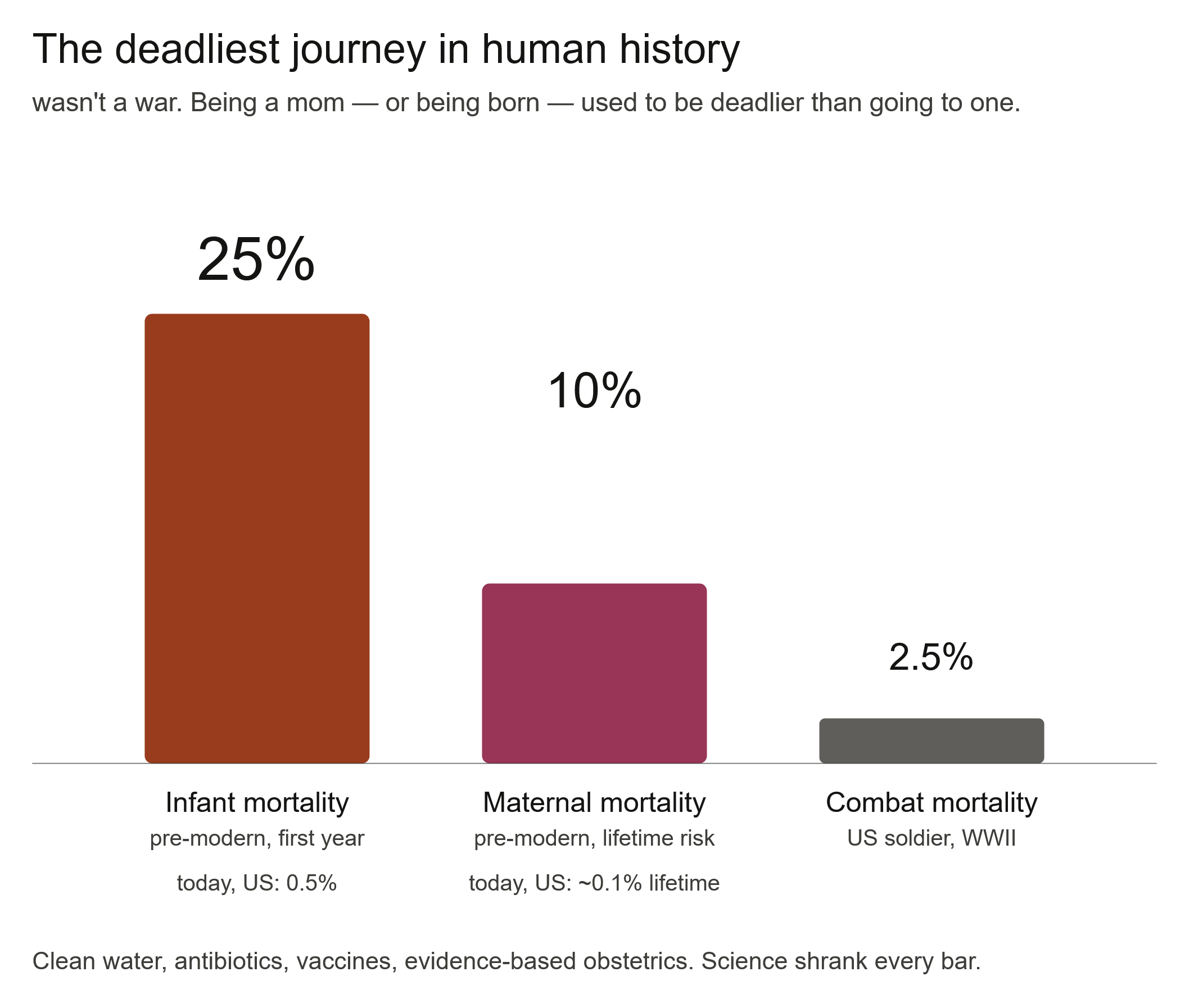
The deadliest journey in human history wasn't a war.
- Pre-modern infant mortality: 25%.
- Pre-modern maternal mortality, lifetime risk: ~10%.
- US soldier mortality in WWII: 2.5%.
Motherhood was 4 times deadlier than combat. Science and modern medicine changed that.
(The US Civil War (~1 in 5 soldiers) and the Napoleonic Wars (~1 in 3 French soldiers) had mortality rates closer to pre-modern motherhood and infancy than to WWII, and for the same reasons: sepsis and disease, not bullets. Germ theory was the common cure.)
SciFi, Fantasy, & Me
I just watched Wicked for Good. Apart from the fact that all of the allegories from the original books are lost in the Phantom Menace-esque, Elphaba “created” everyone storyline, the characters display all of the emotional depth and social complex of not particularly bright teenagers.
I recommend Tad Williams’s Otherland series for a dark cyberpunk take on Oz and other tales.
Stage & Screen
- May 12, Online: I'll be reading from Robot-Proof for the The Library Speakers Consortium.
- May 12, SF: We'll talk about collective intelligence, the neuroscience of trust, and how dumb I have to be to be launching my 13th company.
- May 14, Miami: TEDxMiami
- June 9-10, London: London Tech Week!
- June 11, Luxembourg: How Europe (and even some of it smallest states) compete and grow in a trade environment dominated by zero-sum leaders
- June 12, Denver: GlobalMindEd
- June 18, Stockholm: The Smartest Thing on the Planet: Hybrid Intelligence
- October, Toronto: The Future of Work...in the Future